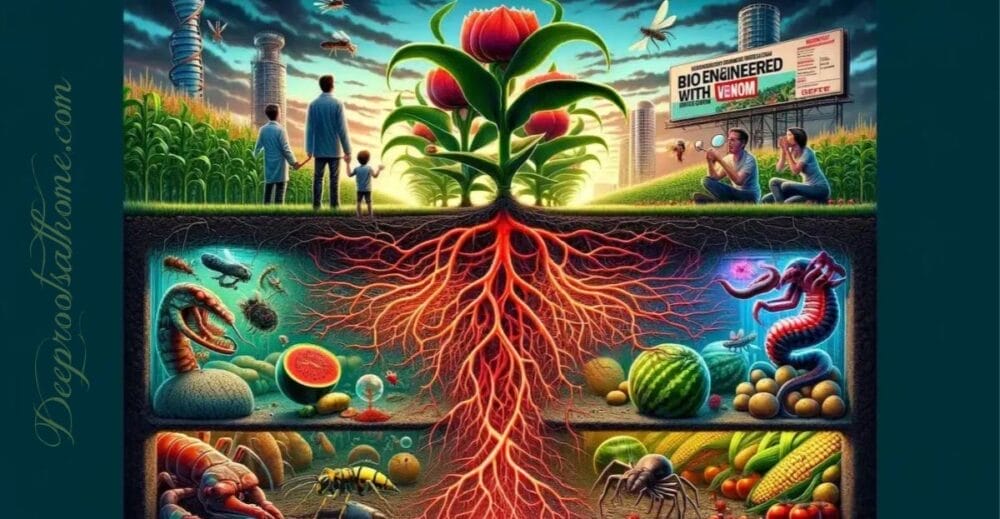
The Shocking Truth About Venom Genetically-Engineered Vegetable Seeds
Imagine biting into a fresh tomato or serving up a bowl of rice, unaware that deep within the plant’s DNA lies a venom protein borrowed from a snake, scorpion, or spider. It sounds like science fiction, but it’s not.
According to a peer-reviewed study published in the journal Venoms (November 2021), scientists have been exploring ways to incorporate venom proteins into vegetable seeds as a new line of defense against insects… and those developments may already be far more widespread than the public has been told.
Venom for Dinner? The Study That Started the Alarm
The journal article, titled Applications of Venom Biodiversity in Agriculture, outlines a growing body of research in which venom peptides… proteins derived from creatures like snakes, spiders, and scorpions… are used to engineer pest-resistant plants.
The rationale?
According to the study’s authors, venom-based biotechnology holds promise for creating what they call “bioinsecticides.” The idea is that plants, through genetic-engineering, can internally produce venom proteins that repel or kill attacking pests. It’s been offered by marketers as a more “natural” solution than synthetic pesticides.
But some researchers aren’t convinced… and the backlash is growing.
Dr. Bryan Ardis and G. Edward Griffin, have raised red flags about this development, warning that such extreme forms of genetic engineering could have unintended consequences, both ecological and medical.
12 minutes.
Behind the Genetic Curtain: Who’s Engineering These Seeds?
The research paper’s graphics, recently circulated in an exposé presentation that’s gone viral, reveal a startling matrix: color-coded dots representing venom types (red), corporations and universities (blue), and the genetically engineered crops (green) that carry these toxic traits.
Among the companies named are agricultural giants like Bayer, Monsanto, BASF, and even food processors like Frito-Lay. The crops? Everything from rice and corn to potatoes, melons, celery, lettuce, and even stevia.
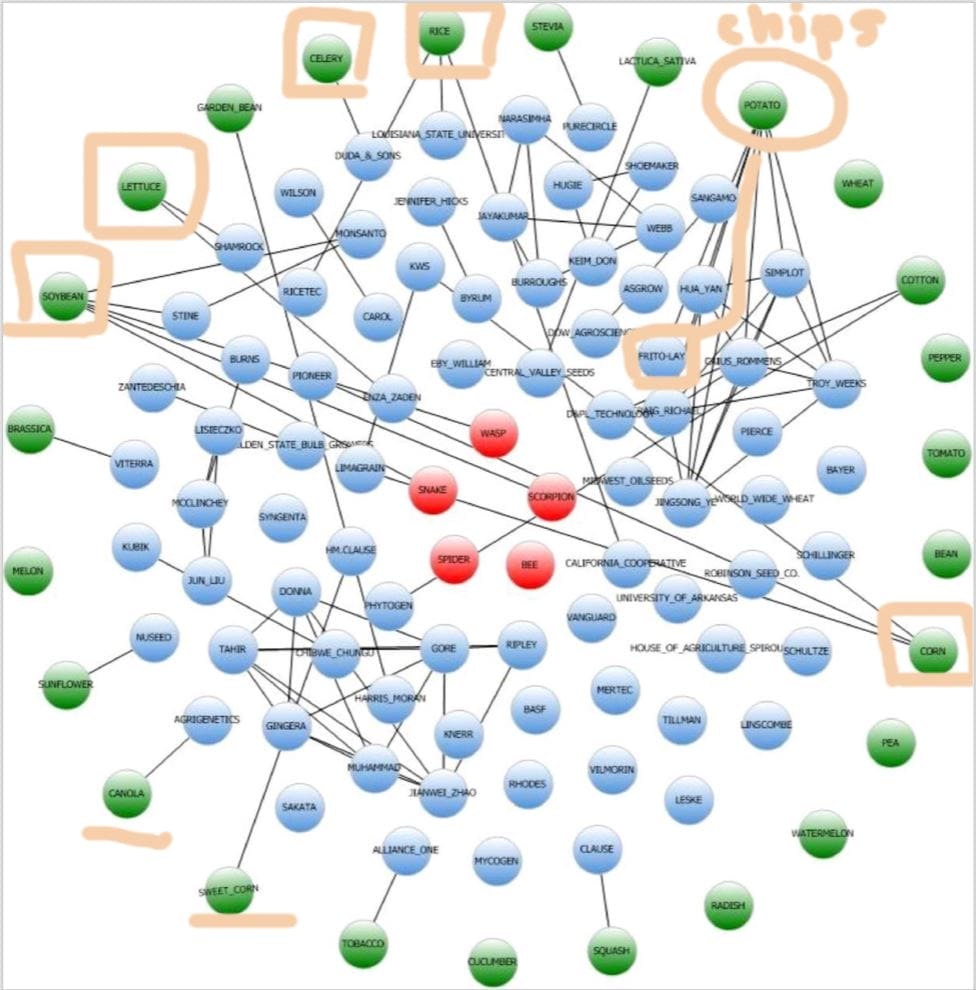
Louisiana State University and the University of Arkansas appear alongside multinational corporations in holding patents.
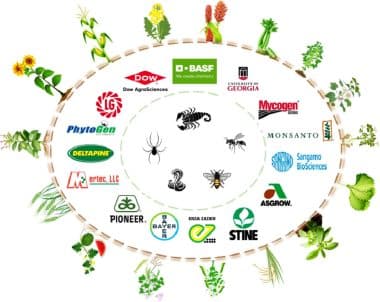
It’s LEGAL To Sell Venomized Seeds In The U.S.!
If this technology is so beneficial, why hasn’t the public been informed?
One reason is that by law, GMO seed-engineering labels are not required in the U.S. The USDA’s National Bioengineered Food Disclosure Standard requires labeling of bioengineered foods for human consumption, but this does not specifically address seeds.
Why Weren’t We Told About the Venom?
The authors of the Venoms study states the result is that the vegetable plant itself becomes toxic to insects, potentially reducing the need for external pesticide applications. These GMO venom proteins are produced systemically throughout the plant, and of course, they end up in the leaves, stalks, roots, and the parts we eat.
From Biotech to the Buffet: Dangerous Venom in the Food Chain
The biotechnology industry argues that venom-derived proteins used in agriculture are carefully selected for specificity… meaning they are lethal to pests, but supposedly safe for humans.
Some venom components, like Exendin-4 (found in the venom of the Gila monster), are already being used in drugs like Ozempic and Wegovy to manage diabetes and weight loss.
The black box warning on Ozempic and Wegovy primarily concerns the increased risk of thyroid C-cell tumors. Specifically, the warning states that semaglutide causes thyroid C-cell tumors in rodents at clinically relevant exposures. At this point, with no long term studies, no one really knows whether semaglutide causes thyroid C-cell tumors, including medullary thyroid carcinoma (MTC), in humans yet!
While this is called a “breakthrough” in medicine, critics argue that venom uses raise even more concerns when similar proteins are being embedded in our food supply without public knowledge and NO long term studies!
Let’s say that again… where are the long-term studies?
“Trust Us, Venom Is Safe”: The PR Problem in Modern Agriculture
There’s precious little public awareness, no major campaigns informing consumers, and apparently no labeling requirements. Even farmers may be unaware of the full implications of the seeds they’re planting if patents and proprietary protections keep those details hidden.
Now, when consumers are eventually informed… through whistleblower presentations, leaked graphics, or patent searches… the reaction is one of disbelief, followed by outrage.
The Case for Transparency and Consumer Choice
Whether you support or oppose genetically-engineered crops, the use of venom proteins raises serious ethical, medical, and ecological questions. Should a food company like Frito-Lay own patents on venom-producing potatoes that millions consume regularly?
If biotech firms and public institutions are confident in the safety and benefits of this technology, they should welcome informed debate and transparent labeling. Anything less begins to look less like innovation and more like concealment.
This all reminds me of COVID and the “safe and effective” claim by the vaccine companies, the media, and our own government.
Are We Guinea Pigs in a Global Experiment?
The application of venom biotechnology in agriculture may be one of the most shocking developments in food science. It touches on everything from food safety and corporate power to medical ethics and environmental stewardship.
As this technology continues to advance without guardrails, one thing is certain: the public deserves a full understanding of what’s being served. The last thing we want for our family is a harvest that looks great but is toxic.
Until we know more, use caution. Buy and plant heirloom seeds. We sell them, but so do a lot of other good companies.
Excerpts from Bill Heid at Off the Grid News.
See 4 Ways To Keep Monsanto Out Of Your Home Garden which lists dozens of companies that specialize in heirlooms and that are NOT owned by Monsanto or Seminis.
The legacy of Seed Savers Exchange is to tell you how to collect and store seeds now before they are tainted.
“Then God said, ‘Let the earth bring forth grass, the herb that yields seed, and the fruit tree that yields fruit according to its kind, whose seed is in itself, on the earth’; and it was so. And the earth brought forth grass, the herb that yields seed according to its kind, and the tree that yields fruit, whose seed is in itself according to its kind. And God saw that it was good.” ~Genesis 1:11-12 [italics mine]
“Now the serpent was more cunning than any of the wild animals the Lord God had made. He said to the woman, “Did God really say, ‘You must not eat from any tree in the garden’?” ~Genesis 3:1
****For the Full Spike Protein Protocol to protect from transmission from the “V” and to help those who took the “V”, go here.
***If you found value in this writing, please share it, discuss it, and subscribe to my FREE newsletter. Ad-free, independent work like this spreads because of readers like you.
Also, consider supporting my work by using my Amazon affiliate link when purchasing from there.
Censorship is real, so my Pinterest account was suspended; thankfully, a big part of my main board is still alive through this link!
You can also find me on Facebook, Gab, MeWe, X (Twitter), and Instagram.
Medical Disclaimer: I am no longer a practicing medical professional, and I am not doctor. I am a mother. I do seek scientific confirmation of the safety and effectiveness of the herbs and remedies I use. Using remedies is a personal decision. Nothing I say on this blog is intended to treat or prevent disease. Consult your own doctor.©2026 Deep Roots at Home • All Rights Reserved










chuck
Hello Earthlings,
Reminds me of…
Matthew 7:10 Or if he asks for a fish, will give him a snake? –
?
organized crime will gladly give us a snake and then exploit our suffering?
Keep us and U.S. sick and exploit that sickness?
I am sorry Humanity… that is who is running and ruining Earth in my opinion.
Not the Creator but the Pragmatic business galactic…
blessings
chuck 🔥💖🔥
once known as
Sativarg אברא
Jacqueline
Hi, Chuck (oka Sativarg),
I couldn’t agree more!!! Thanks for your astute comment.
Blessings,
Jacqueline
Debbie Ford
I am horrified by this! I hope there will be a way for us to know which foods contain venom. With the physical issues I have, I can do very little gardening.
When I click on the link for your affiliate page, I don’t see anything about you. How does it work?
Jacqueline
Hi, Debbie,
I don’t have an affiliate page, but I do have an about page. https://deeprootsathome.com/about/
Are you wanting to know if there are any products I have affiliation with?
I rep for TRS for now, but am finding a few more wonderful, effective products besides that I may also rep. I want people to heal and be in good health, so I am considering 2 more, but time is an issue!
I am horrified, too! I am praying for your good health now as I type. May the Lord bless you spiritually and physically!
Jacque