

Thanks to epidemiologist Nicholas Hulscher, MPH, we now know that just seven daily doses of nano-curcumin dropped Cyclospora shedding by 97.2%, eliminated detectable parasites, restored damaged intestinal tissue, and prevented infection relapse.
Cyclospora infections are surging across the United States. Caused by the microscopic intestinal parasite Cyclospora cayetanensis, the infection can trigger prolonged watery diarrhea, severe abdominal cramping, nausea, fatigue, and weight loss that may persist for weeks without treatment.
As of July 17, 2026, the CDC had confirmed over several thousand domestic cases acquired cases across 31 states, with over 100 hospitalizations, while the contaminated food sources as of today have not yet been identified.
Bactrim, a sulfa drug that is known to also cause nausea, diarrhea, and skin changes, is the usual treatment for cyclosporiasis, so many are seeking natural alternatives.
Beware: sometimes recommended as a second tier treatment, black box fluoroquinolone antibiotic Cipro can cause horrific damage to muscles, tendons, and also serious DNA changes. Please do not go that route!
A recent study identified curcumin—the primary bioactive pigment in turmeric—as a potentially powerful natural treatment for Cyclospora infection. In mice, just seven daily doses of nano-curcumin reduced parasite shedding by 97.2%, eliminated detectable parasites, restored damaged intestinal tissue, and prevented relapse after treatment withdrawal. Nano-curcumin is curcumin packaged in extremely small oil-based droplets (30–40 nanometers) designed to improve its delivery and absorption.
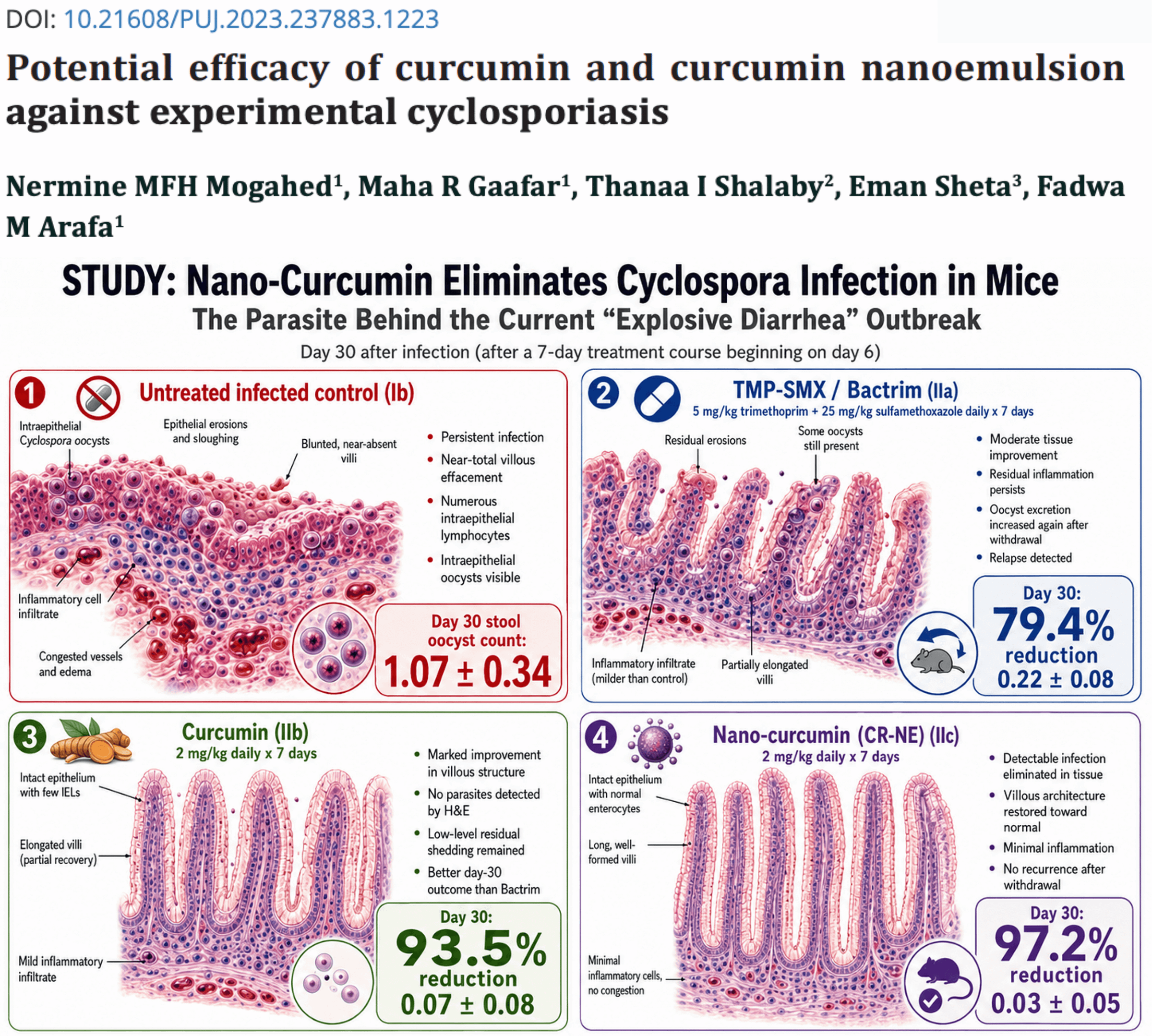
Researchers experimentally infected mice with Cyclospora and compared three treatments:
- Nano-curcumin: 2 mg/kg once daily
- Regular curcumin: 2 mg/kg once daily
- Bactrim/TMP-SMX: 5 mg/kg trimethoprim plus 25 mg/kg sulfamethoxazole once daily
Each treatment was administered for only seven consecutive days, beginning on day 6 after infection when parasite shedding started. The mice received no additional treatment and were followed through day 30—more than two weeks after the final dose.
Nano-curcumin produced the strongest overall results.

By the end of treatment, parasite oocyst shedding had fallen by:
- 84.0% with nano-curcumin
- 77.3% with Bactrim
- 73.3% with regular curcumin
At day 30, more than two weeks after treatment ended:
- Nano-curcumin: 97.2% reduction
- Regular curcumin: 93.5% reduction
- Bactrim: 79.4% reduction
- Untreated control: persistent and increasing shedding
All three treatments significantly reduced Cyclospora shedding compared with the untreated control.
The mean stool oocyst count at day 30 was 1.07 in untreated infected mice, compared with 0.22 in the Bactrim group, 0.07 with regular curcumin, and just 0.03 with nano-curcumin.
Nano-Curcumin Prevented Relapse
The most important result was not simply the reduction in parasite shedding.
The authors also reported no recurrence after nano-curcumin treatment. Unlike regular curcumin and Bactrim, no rebound in infection was detected after treatment withdrawal. No parasite was found in intestinal tissue by standard histological staining, and the researchers stated that the infection appeared to have been eliminated.
Thus, seven daily doses of nano-curcumin produced a sustained 97.2% reduction in parasite shedding, with no detected intestinal parasites or relapse more than two weeks later.
Regular Curcumin Was Also Highly Effective
The ordinary curcumin group also performed remarkably well.
After the same seven-day course, regular curcumin reduced parasite shedding by 93.5% at day 30. No parasite was detected in the intestinal tissue at that time point.
The main distinction was that low-level stool shedding remained, so the authors did not describe regular curcumin as preventing recurrence as clearly as the nano-curcumin emulsion. Still, the findings suggest that curcumin itself has substantial anti-Cyclospora activity, while nano-formulation may enhance and prolong its effect.
Curcumin Damaged the Parasite and Restored the Intestine
Scanning electron microscopy (SEM) revealed extensive structural damage to Cyclospora oocysts following treatment with both forms of curcumin.
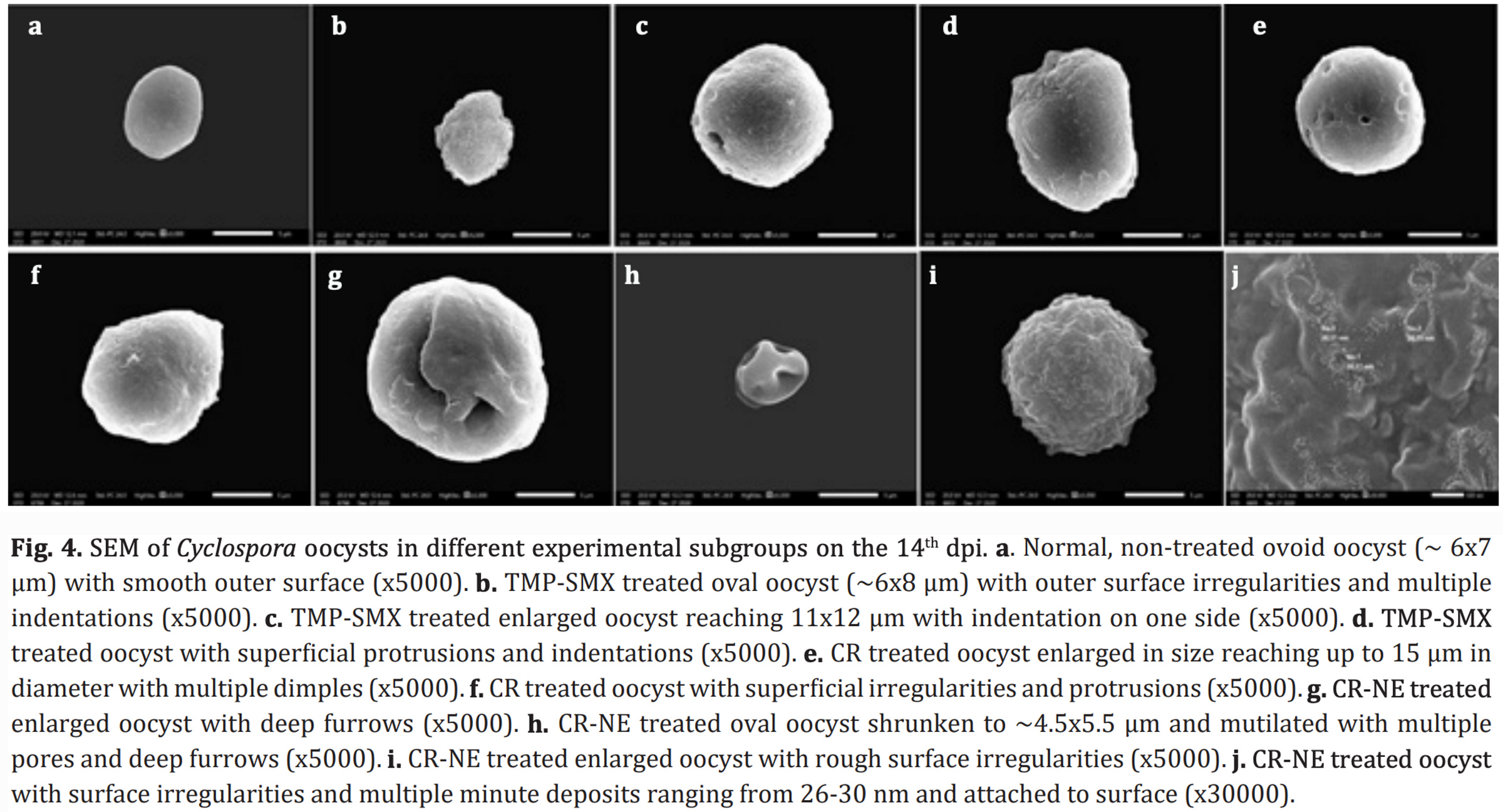
Untreated oocysts had smooth, regular outer surfaces. Curcumin-treated oocysts became distorted and developed dimples, protrusions, and surface irregularities. Nano-curcumin produced even more dramatic damage to the cyclospora oocyst, including enlargement or shrinkage, deep furrows, pores, perforations, and rough surface damage.
The intestinal findings were equally striking:
Untreated infection caused shortened and blunted villi, epithelial erosion, inflammation, and progressive destruction of the absorptive intestinal surface. Both Bactrim and regular curcumin improved the intestinal tissue, but nano-curcumin produced the greatest recovery.
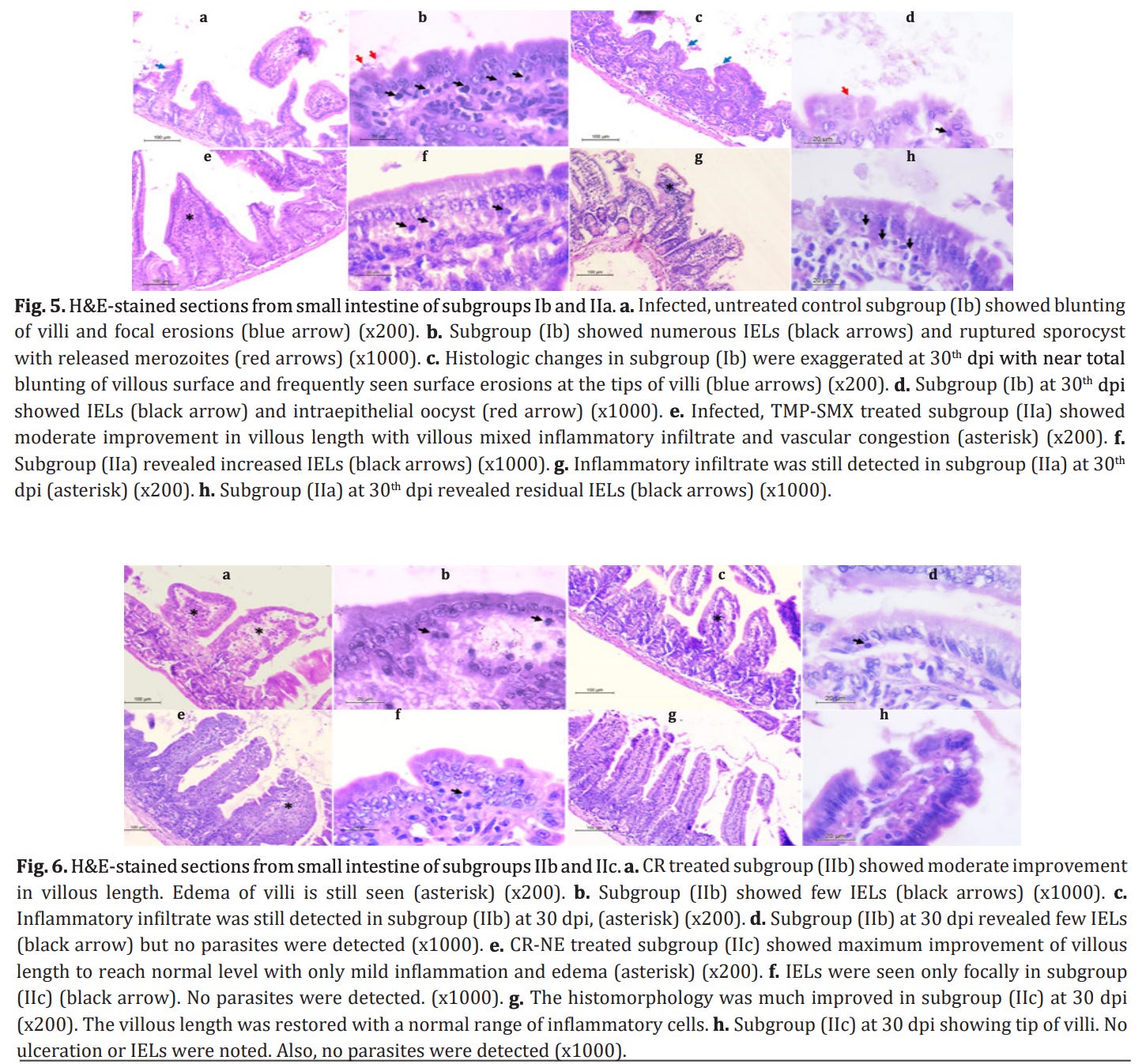
Results: In the nano-curcumin group, the intestinal surface remained intact, inflammation declined markedly, villous length returned toward normal, and no parasites were detected in the tissue.
Why Nano-Curcumin May Matter
Curcumin has demonstrated antiparasitic, anti-inflammatory, and antioxidant properties, but poor water solubility and limited bioavailability have restricted its therapeutic potential.
The nanoemulsion used in this study contained particles measuring approximately 30–40 nanometers. This formulation may improve curcumin’s solubility, stability, biological activity, and contact time with the intestinal parasite.
Because Cyclospora infects the small intestine, orally administered curcumin may also remain concentrated near the site of infection. The strong performance of regular curcumin supports the compound’s underlying antiparasitic activity, while the improved results with nano-curcumin suggest that drug delivery may be the key to maximizing that effect.
I, Jacqueline, already take this turmeric daily, but am switching over to this nano-curcumin as a preventative move because it is in the right nanometer size range.
Conclusion
Bactrim remains the treatment of choice for human cyclosporiasis because it has direct clinical evidence in infected patients. Human clinical trials have shown that TMP-SMX successfully treats cyclosporiasis and can shorten average parasite shedding from 12.1 days to 4.8 days.
Curcumin and nano-curcumin, by contrast, have not yet been tested in human patients with cyclosporiasis. Their evidence for this infection currently comes from this animal study.
However, given turmeric and curcumin’s non-toxic nature even at very high doses and myriad other benefits, I will have it in my arsenal in case of infection. ~Nicolas Hulscher, MPH, epidemiologist
Controlled human trials are now needed to determine whether these striking results can be reproduced in people.
Many thanks to Nicolas Hulscher, MPH, Epidemiologist
***For the Full Spike Protein Protocol to protect from transmission from the “V” and to help those who took the “V”, go here.
***If you found value in this writing, please share it, discuss it, and subscribe to my FREE newsletter. Independent, ad-free work like this spreads because of readers like you.
Also, please consider supporting my work by using my Amazon affiliate link when purchasing from there.

Censorship is real, so my Pinterest account was suspended; thankfully, a big part of my main board is still alive through this link!
You can also find me on Facebook, Gab, MeWe, X (Twitter), and Instagram.
Medical Disclaimer: I am no longer a practicing medical professional, and I am not doctor. I am a mother. I do seek scientific confirmation of the safety and effectiveness of the herbs and remedies I use. Using remedies is a personal decision. Nothing I say on this blog is intended to treat or prevent disease. Consult your own doctor.©2026 Deep Roots at Home • All Rights Reserved
















Related