
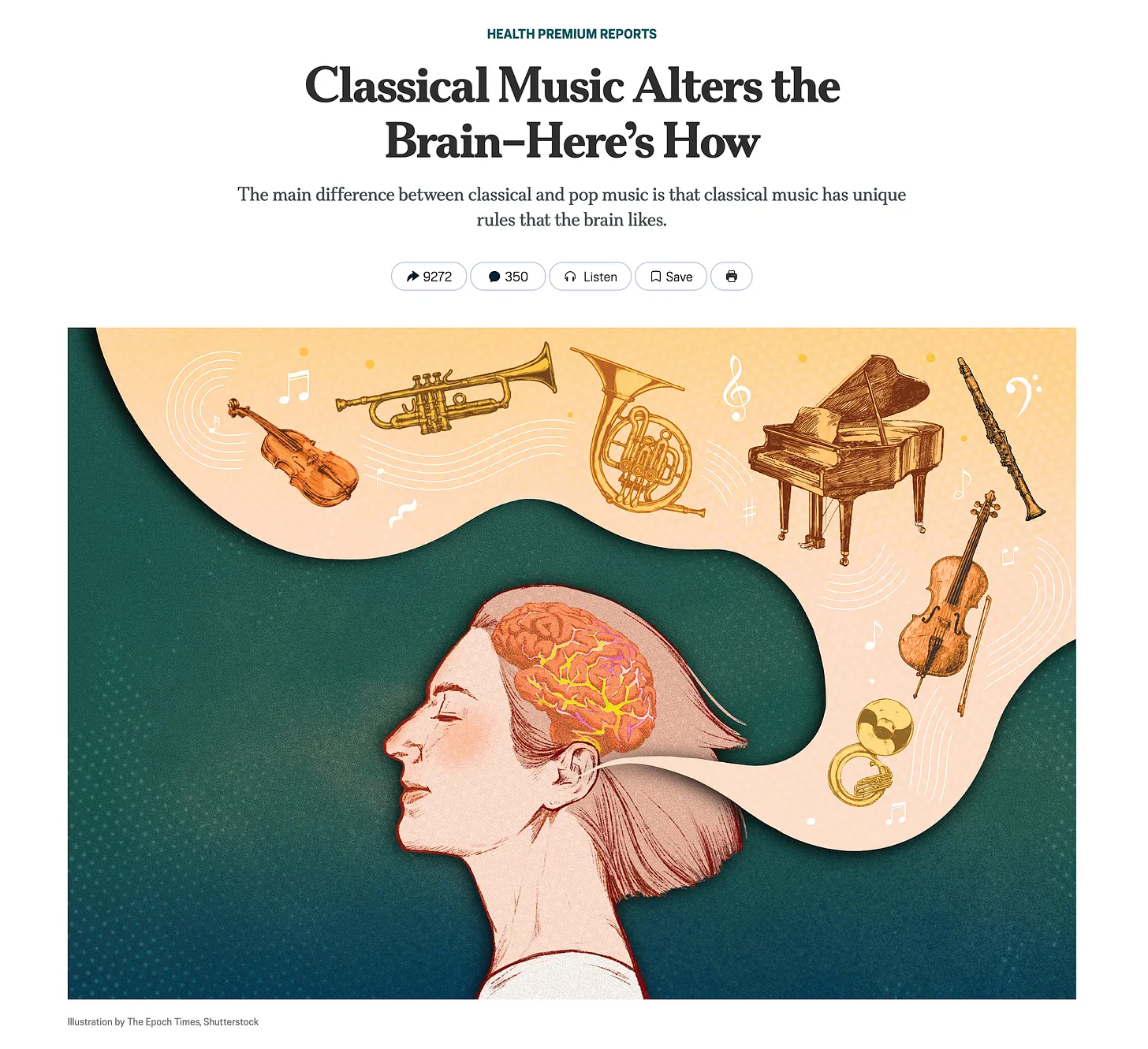
Every once in a while, I stumble on a piece of life-giving information that grabs my heart so much that I must get it into as many hands as possible. From their birth, and throughout the years we were raising and homeschooling our kids, I decided to give them a love for great music through immersion. So today, I’m taking a break from the medical side to bring you something that may just bless and change your whole life: these excerpts from this Epoch Times article by Flora Zhao on classical music.
Now, before you move on, thinking this will be boring, give me just three short minutes to change your mind.
It turns out the “Mozart effect” reaps massive health benefits, and you don’t have to be a musician to reap the benefits. Take dementia patients, for example.
Professional violinist Ayako Yonetani told The Epoch Times that when she performs for people with dementia, something remarkable happens: they often become more alert, are visibly moved by the music, and at times experience moments of clarity with their families again.
In one particular case, a gray-haired older woman, whose cognition was degraded to sitting motionless with her gaze lowered, suddenly had “her eyes brightened” as she tried to follow along with Yonetani’s performance.
The family reported that “They had never seen her react like this before,” but Ms. Yonetani says this was just one of many times where she noticed a staggering response in dementia patients.
The benefits extend beyond just people with dementia, and the more you expose yourself to classical music, the bigger the benefits become. When classical musicians undergo brain scans, what doctors discover is that certain parts of their brains barely shrink over time.
Specifically, when it comes to gray matter—the part of the brain responsible for processing information, remembering things, and managing emotions—symphony orchestra musicians had significantly higher levels, not just at age 65 but even earlier.
By the time you reach the age of 65, the difference between the two groups is about 70 cubic milliliters of gray matter (440 vs 370), or about 19% more for musicians.

Classical music has been shown to:
• Reduce epileptic brain activity in people prone to seizures (PubMed study).
• Decreased seizure recurrence in about 45% of children (PubMed study).
• Strengthen neural connections and improve the brain’s communication network (source)
• Increase milk and egg production. (source)(source)
• Reduce stress, anxiety, pain (raises endorphins), lowers cortisol and inflammation in cancer patients. It increases oxytocin. (source)
• Improve mood, behavior, and sleep quality
• Trigger pleasurable “chills” and activate the brain’s reward (dopamine) system
• And supposedly, it can even make you appear more charming when played during social occasions (such as dates)

What Makes Classical Music Different?
You can think of classical music as kind of a “workout for your brain.” Unlike much of today’s popular music, it weaves together rapid passages, slow sections, and shifts from whisper-soft to megaphone-loud—all intricately connected within a single composition.
With most pop songs, one can often predict exactly how the rest of the song will unfold after hearing the first chorus—even on the very first listen.
That’s not the case with classical music.
It surprises you and stirs deep emotion as it carries you along on a journey. While classical music usually follows precise numerical patterns, the richness and variety within each piece keep the experience fresh and engaging.

Remarkable Lifelong Benefits
High school students who participated in an instrumental music program scored, on average, 63 points higher on the verbal section of the SAT and 44 points higher on the math section.
High school band members have an 88.4% chance of graduating from college, compared to the national average of just 60.4%. That’s nearly a 50% higher chance of graduating from college based on that one factor alone. That is profound.
Even modest musical training can have lasting benefits. This study shows that people who had learned to play just a single instrument during childhood, more than 50 years later, still showed a measurable cognitive advantage over those who never played.
To sum it up, if you have a child and want them to succeed in life, encouraging them to learn how to play an instrument could be the most impactful educational decision you ever make as a parent.

More Brain Benefits of Listening
For listening, the benefits of classical music are modest when it comes to cognitive gains, but the improvements to anxiety, focus, and other areas are quite significant.
• A 2019 study found that daily classical music listening for two months led to a 12% drop in baseline (trait) anxiety in college students (statistically significant). In other words, their overall anxiety was lower throughout the day, not just while listening to the music.
• In 2021, a review of 12 studies found that listening to Mozart’s Sonata for Two Pianos in D major (K.448) reduced abnormal brain activity linked to seizures in 84% of people with epilepsy.
• A 2007 study found that simply listening to classical music in the background can also help the brain adsorb and interpret new information more easily.
• In 1993, Nature published a study showing that just ten minutes of listening to classical music can temporarily boost your spatial IQ by around ten points.
• A 2024 study found that patients with treatment-resistant depression had significant mood boosts after listening to classical music.
• Lastly, playing classical music before bed can help you fall asleep faster and improve sleep depth. One study noted that participants fell asleep 35% quicker with soothing classical tracks.

I was raised by a Dutch father who had a vast collection of classical and international folk music, and it was played often in our home. While I don’t think he was playing it intentionally for us children, we all still find it incredibly satisfying to listen to, and it is a rich part of our lives. Plus, it is fun and puts one in a better mood.
It thus becomes a generational endeavor to immerse our children while they are young.
Explore classical music, and you may find it’s hard to listen exclusively to modern tracks. The variety in classical compositions is like a workout for the brain, constantly keeping it engaged.
Pop songs, on the other hand, get repetitive fast—and you can often predict how they unfold on your first listen.
Try this experiment: watch Mari Samuelson play wild and furious Summer from Vivaldi’s Four Seasons and see if it doesn’t give you chills! It’s a journey from start to finish, a true work of art. Then play some modern music and tell me it doesn’t feel like brain rot by comparison.
10 minutes.
And this is very cool 9 minutes, and a fun way to learn the genre…
Getting Started
Humanity has made astonishing progress in science, technology, and medicine in recent decades. But more than 300 years after Bach first graced the world with his music, where we are now feels like a huge step backward.
The difference is so stark that it makes you wonder if today’s music is designed to be lacking substance on purpose.
Some of my favorite music resources for your listening pleasure while you work, cook, study, teach or prepare to sleep:
50 Classical Music Masterpieces for Relaxation & the Soul | Beethoven, Mozart, Chopin, Bach, Vivaldi – one of my favorites..very relaxing
The Hidden Treasures of Royal Baroque Music BACH, VIVALDI, CORELLI..
J.S. Bach: The Violin Concertos
Handel’s Celestial Masterpieces
2 Hours of Celtic Music by Adrian von Ziegler – simply epic!
The Best Of John Williams Playlist Collection
Healing Music For Body and Brain, Sleep, & Baby’s Brain Development:
***Peder B. Helland has the BEST sleep and peaceful background music, all are ad free: Dance of Life, Flying,
Classical music to help restore the brain after injury, increase memory, restore good mood
Baby Classical Music 🌞 Mozart, Schubert & Chopin 🌞 Piano Songs for Babies
Mozart – Classical Music for Brain Power
Bach – Classical Music for Relaxation
Focus Music for Work and Studying, Background Music for Concentration, Study Music
Music with Lyrics Can Heal and Restore the Brain:
Researchers at the music and neuroimaging laboratory at a Harvard-affiliated Medical Center have shown that singing lyrics can be especially helpful to people who are recovering from a stroke or brain injury that has damaged the left-brain region responsible for speech. Because singing ability originates in the undamaged right side of the brain, people can learn to speak their thoughts by singing them first and gradually dropping the melody. Former Representative Gabrielle Giffords used this technique to learn to speak well enough to testify before a Congressional committee two years after a gunshot wound to her brain damaged her ability to speak.(source)
Worship and Faith Strengthen Soul, Body and Mind:
To draw close into Jesus and hear the Holy Spirit speak, I listen to Michael W Smith Worship LIVE in Canada
“Praise him with trumpet sound; praise him with lute and harp! Praise him with tambourine and dance; praise him with strings and pipe! Praise him with sounding cymbals; praise him with loud clashing cymbals!” ~Psalm 150:3-5
****For the Full Spike Protein Protocol to protect from transmission from the “V” and to help those who took the “V”, go here.
***If you found value in this writing, please share it, discuss it, and subscribe to my FREE newsletter. Independent, totally ad-free work like this spreads because of readers like you.
Also, please consider supporting my work by using my Amazon affiliate link when purchasing from there.

Censorship is real, so my Pinterest account was suspended; thankfully, a big part of my main board is still alive through this link!
You can also find me on Facebook, Gab, MeWe, X (Twitter), and Instagram.
©2026 Deep Roots at Home • All Rights Reserved











Katie
YAY! THANK YOU SO MUCH FOR THIS!
I raised my kids on classical, folk music, and hymns. They all play a few instruments. I grew up with a huge variety b/c my Dad was a music/choir teacher. I played a few instruments and we were all in choirs.
My music of choice during my teen years was Christian Rock, which I still enjoy with some very good memories. My kids usually hate it when I turn it on!… so I seldom play it.
I can’t WAIT to listen to your suggestions above. Last year I started piano lessons and now I’m also eager to practice more…
Some of the most important habits in life I learned in choir, orchestra, and band. Like warm ups, good posture, breathing properly, listening to those around you, and so on.
Last year I listened to an interview w/ Barbara O’Neill and she said the three best habits to improve brain health are 1) memorizing Bible, 2) playing a musical instrument, and 3) learning a new language.
Thanks again! God bless you and your family.
Katie
Jacqueline
Hi, there, Katie,
Thank you for sharing your musical memories 🙂 It sounds like our backgrounds and tastes are very similar! I personally enjoyed A capella choir, swing choir, and piano as a student, but my fondest memories years later was when our children started playing dulcimer together and demonstrated very different personalities on the piano!
It was such fun to watch them spontaneously jam and play Irish music and hymns. God is so good!
And, yes, Barbara O’Neill is right on!
Blessings,
Jacque
Sue Beer
Clair de Lune by Debussy or maybe Beethoven’s 9th.
Jacqueline
I think both of those are in one of the videos at the end. 🙂 -J
Sue Beer
I was always fascinated about Beethoven. I believe he was totally deaf when he composed the 9th. That in itself is quite an accomplishment. Many years ago, I played the Moonlight Sonata for a church prelude. Well over halfway through you could hear a pin drop. Normally people are socializing in the pews. That freaked me out momentary. They were actually listening!
Jacqueline
Sue, that is a great memory! And an insightful one. I loved playing that piece many years ago… and yes, people do listen!
Thank you for sharing that with me, and that you are a pianist! ~J
Faith
My teenage children love classical music. I’m not exactly sure how this happened but they are absolutely fascinated by it. I always played classical music for them, especially baroque and Catholic Masses and sacred music by Vivaldi and Mozart. Then about 9 years ago when six of my kids were ages 4 through 14, I downloaded a concert of Handel’s Messiah onto my teeny tiny phone. They fell in love with it and from there eventually taught themselves how to sing together in 3 or 4 parts. They memorized every inch of that concert. I only let them watch it from the beginning of Advent until the end of the liturgical Christmas season (Feb. 2). They were not allowed to listen to it during other times of the year. This was to help them not get bored with it, and to look forward to hearing it every year. Now they can’t wait to hear it every year. It has become a special treasure during the Advent and Christmas seasons!
Faith
I have a tip for falling in love with classical music. Pick a piece — I recommend Vivaldi The Four Seasons or Mozart piano concerto 21 K467 or one of the Beethoven symphonies (you can’t go wrong with the 5th, 6th or 7th.) Just pick one piece for now. Now listen to the whole thing every day for a week. (If you have kids, get them involved!) Play it loud, without damaging your ears, of course! Don’t talk, at least not too much. Kids can color or draw while listening. I usually fold laundry, or make dinner, or grade schoolwork. You will find that you will begin to recognize and look forward to special little parts of the music, and soon you will be in love.
My kids and I did this recently with all 9 Beethoven symphonies. We were not familiar with most of them. So I bought a set of CDs. Each Sunday one of the children picked a piece of paper with numbers 1 through 9 out of a hat, and that was our symphony of the week. We really fell madly in love with Beethoven.
Although YouTube can be a dangerous place, there is an excellent classical music channel that is ad free. It’s called
“hr-Sinphonieorchester – Frankfurt Radio Symphony.” Watching classical music can be life changing. And that channel is a great one. The camera work is excellent because the cameramen know music, and know who to focus the camera on. Happy listening!
Jacqueline
Faith, I am thrilled to read your 2 comments! We did something similar to what you did when we homeschooled and as a result, all our 3 children also grew to love classical music and hymns. My daughter and I have sung in a Handel’s Messiah performance – my daughter went on to sing soprano a number of times. What a wonderful outcome our families have had as a result of listening to such a rich diet of wonderful, God-given classical and Baroque music from a young age. So great for the brain and the soul!
Thank you for sharing your experiences and it is my prayer that others will do it as well.
God bless you and yours,
Jacque
Ruth
This is a wonderful post! I wanted to pass it along to my kids for their families, but, oh dear, can you please remove that link to Katy Perry’s dreadful video? I unfortunately did the suggested experiment, and now feel contaminated and unclean by watching it.
Jacqueline
Thanks, Ruth, for the suggestion, and I am so sorry that it made you feel unclean. I will go back and reconsider it when I have a minute. I do hope it will shock someone into considering what they regularly consume! ~Jacque
Jacqueline
Ruth, I think the new example of “junk” music I just added is so much better than the Katie Perry video.. check it out now.
I must confess, I failed to even play that Katy Perry video when I shared that “Sound” post. What I added is much more representative of what I wanted to convey!
Glad you let me know!
Jacque
Jacalyn
Different subject: I’d like the name or link to that Company that customizes DRESSES that you have shown in the past. I need a fancy dress to go to my Granddaughter’s wedding, in Sep. Thanks.
Jacqueline
Jacalyn,
Is it Thred Up? The link is in here: https://deeprootsathome.com/modesty-empowers-women-nudity-doesnt/
Or could it be eShakti where you can get custom dresses? The link to that is in here: https://deeprootsathome.com/modest-feminine-dressing-for-the-plus-size-woman/
I hope it is one of them bc I can’t think of another possibility that you’ve seen here on DRAH.
Blessings,
Jacque
Jacalyn
Hi Jacque, I just checked online and eShakti is OUT of business. Another company, SURMISSURA, I think is how it was spelled, is recommended, instead. I hope this helps somebody. Jacalyn B
Jacqueline
Jacalyn,
I apologize that I wasn’t able to check that link out before I sent it to you! Just out of time with our 8th new grand child just born and 2 more due in November. The oldest is 6 :0) They all live close by, as well, so it is very busy. You understand, I’m sure! What an amazing time!
Have a wonderful and blessed time at your granddaughter’s wedding!
Blessings, J