
Before the 20th Century: Iodine Was Big News
For a very long time, iodine was valued. For centuries, coastal populations around the world missed out on the swollen neck condition we now call goiter more often than inland populations. Nobody understood the chemistry. They simply noticed that people living near the sea seemed to be healthier than others that didn’t. Seaweed, seafood, and ocean air all became associated with better outcomes.
Iodine was common. Iodine was used as a disinfectant during the Civil War and for use during surgery to reduce deaths caused by infection. It was issued to soldiers in WWI. Later, my Nana and then my Mom used iodine for our scrapes and cuts.
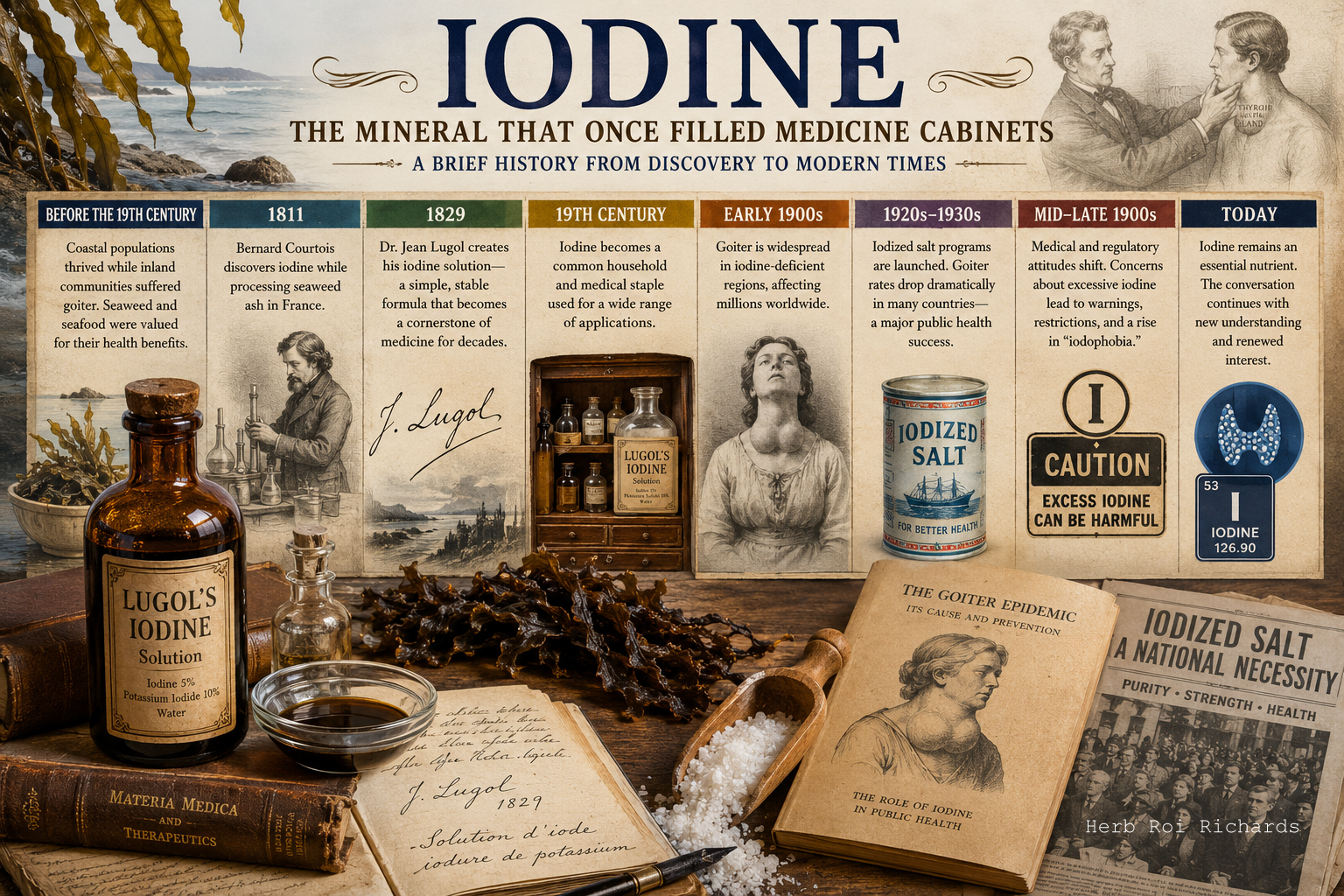
Beginning in the 1920s, iodized salt programs were instituted and goiter rates declined dramatically in many regions. That success story shaped how many today think about iodine: “Don’t worry about iodine. I already get enough from salt.” And that message has largely stuck.
Then somewhere along the way iodine became regarded not as a vital life-giving nutrient – but as a “chemical” to avoid. Once public perception shifts, true history gets forgotten.
But just imagine a universal nutrient that could help you prevent many future diseases… that could also improve mental function, promote ideal hormonal as well as cardiac function, greatly help diabetes, resolve thyroid issues and prevent drug dependence or surgery? And what if this nutrient could kill bacteria, viruses, and fungi that cause disease?
Such a nutrient does exist, and a growing number of doctors are encouraging iodine supplementation. In his best-selling book, Iodine: Why You Need It, Why You Can’t Live Without It, Dr. David Brownstein, Medical Director of the Center for Holistic Medicine in West Bloomfield, Michigan, says iodine is the most misunderstood nutrient.
“After 17 years of practicing medicine, I can say that it is impossible to achieve your optimal health if you do not have adequate iodine levels. I have yet to see any item that is more important to promoting health or optimizing the function of the immune system than iodine.” ~Dr. David Brownstein
I recommend this EXCELLENT video on iodine by Dr. Brownstein. Plus, I’m blown away with his story (at 1:12:00- end) of how, during the height of COVID, the FTC sent him a warning letter to cease and desist from treating and keeping hundreds of patients out of the hospital (and alive). (He was the doctor that recommended adding a drop or 2 of Lugol’s iodine into the nebulizer with very dilute hydrogen peroxide to keep patients out of the hospital – and it saved thousands and thousands of lives.) What an honest, true doctor and hero!
25:00 – 30:00 – he lists the proper supplements to take with iodine and the right form of iodine.
36:00 – 41:30 – he discusses why SALT and HYDRATION are SO important to transport iodine into glandular tissue. Plus, WHY iodine is influential in making all of our body’s hormones.
Many physicians would be surprised to learn that more than a hundred years ago, iodine was called ‘The Universal Medicine’. Some 50 years ago, Nobel laureate Dr. Albert Györgyi, the physician who discovered vitamin C in 1928, wrote: “When I was a medical student, iodine in the form of potassium iodide (KI) was the universal medicine. Nobody knew what it did, but it did something good. We students used to sum up the situation in this little rhyme: ‘If ye don’t know where, what, and why, prescribe ye then K and I.’”
Doctors in the 150 years preceding World War II prescribed KI in large doses for almost every health problem. But since that time there has been a phobia against using iodine in milligram (mg) amounts. This, despite the fact that Japanese people consume ~13.8 mg/day of iodine (100 times the U.S. RDA) and are among the healthiest people on earth, with much lower cancer rates, infant mortality rates, and a 4-year longer life expectancy than the U.S.
Iodine Products Dr. Brownstein Uses In His Practice
• Lugol’s 2% contains 2.5mg/1 drop. It is pure, contains no additives, and has no expiration on shelf life (what we take). • Optimox Iodoral Iodine 12.5 mg and 50 mg tablets. I know many use Iodoral (esp in breast and prostate cancer protocols with their doctor management), but I do not like that Iodoral contains polysorbate 80 and silicon dioxide. Then there are products for very low dose use: Organic Lugol’s Iodine Liquid Drops 3000 mcg/3 drops and Nascent Iodine 1,950 mcg/3 drops. (I wish I knew about iodine when our children were young. Not medical advise – consult your naturopathic or functional doctor.)
Phobia of Iodine & An Increase In Breast Cancer?
Dr. Guy Abraham is a former Professor of Obstetrics and Gynecology at UCLA School of Medicine. In the preface to Dr. Brownstein’s book, he wrote, “Medical iodophobia may have caused more misery and death than both world wars combined, by preventing meaningful clinical research in the daily amount of iodine needed for optimal physical and mental health.” He concludes by saying, “May the Most High God, the Ultimate Healer, and Creator of heaven and earth, continue to guide us and bring to light what was kept in darkness for over 60 years … the safe and effective use of the essential element iodine in the medical practice.”
Dr. James Howenstine, at NewsWithViews.com, writes, “Lack of iodine is widespread in the U.S. today.” For many years iodine was added to bread so that each slice contained 150 micrograms (mcg), the RDA for iodine. In 1960, the breast cancer rate was 1 in 20, and the average American got about 1 milligram—1 milligram (mg) equals 1000 micrograms—of iodine daily, mostly from bakery products. This amount of iodine was enough to decrease thyroid absorption of radioactive iodine, reducing the rate of thyroid and other cancers.
Shortly afterward, the food industry decided to remove iodine from baked goods and replace it with the toxic halide bromine. In 2026, breast cancer accounts for about 30% (or 1 in 3) of all new female cancers each year. (source)
Bromine Is a Poison
Bromine and iodine appear similar to the thyroid, and bromine binds easily to the thyroid’s iodine receptor sites – though it is of no value to the thyroid and inhibits the activity of iodine in the thyroid. Bromine can cause impaired thinking and memory, drowsiness, dizziness, and irritability. This substitution of bromine for iodine has resulted in nearly universal deficiency of iodine among American people. Iodine therapy helps the body eliminate fluoride, bromine, lead, cadmium, arsenic, aluminum, and mercury.
Dr. Abraham believes that somewhere around 13 mg/day of iodine is needed for the whole body. But even that amount is not enough to overcome serious iodine deficiency.
Dr. Brownstein suggests a dose anywhere from 6-50 mg/day, supervised by a physician.
Medical schools have taught for 80 years that there is enough iodine in salt to supply the body’s needs. However, there are no studies to back up this claim.
***And according to a National Health and Nutrition Examination Survey done by the CDC, iodine levels in the U.S. have dropped 50% in the last 30 years. During the same period, breast cancer rates have tripled, and the percentage of pregnant women with low iodine levels has increased 690%. Many studies have shown that children born to these mothers run a significant risk of being born with lowered intellectual ability. One such study measured a 13.5 point difference in IQ scores. In utero iodine deficiency has been associated with a host of childhood ailments including ADD/ADHD, depression, cretinism, dwarfism, and mental retardation.***
Joan’s Story of Iodine Supplementation For Breast Cancer
One of the anecdotes in Dr. Brownstein’s book is about Joan, a 60-year-old English teacher who was diagnosed with breast cancer in 1989. She refused conventional therapy and looked for other options. She found a holistic doctor who recommended that she take 2 mg/day of iodine in addition to vitamins and minerals. She was also diagnosed with hypothyroidism and treated with thyroid hormone. Over the next 10 years, she felt well and continued to teach.
The tumor metastasized in early 2005. Joan’s tumor markers also increased, and she felt very fatigued. She lost 25 pounds by July, 2005. After she read of Dr. Abraham’s research on iodine, she found a doctor to prescribe Lugol’s for her. She increased to 50-62.5 mg/day using a tablet form (Iodoral), which contains both iodine and iodide.
She was then able to stop the thyroid hormone. After six weeks, Joan had a PET scan. It showed that all of the tumors were disintegrating.
Dr. Brownstein says, “Joan’s case is not unique. Iodine can cause tumors to shrink and die from the center. I have observed similar results with nodules and cysts in the thyroid, ovaries, and uterus after instigating Lugol’s supplementation. I concur with several other investigators that iodine deficiency is a causative factor in breast cancer and fibrocystic breast disease.”
He goes on to say that iodine has been shown to induce apoptosis (death) in breast and thyroid cancer cells. Iodine is a potent antioxidant, even more effective than vitamins E, C, and choline. Iodine can function as both an antioxidant and an oxidant in the body. This dual effect makes it a strong anticancer agent.
Survival rates for breast cancer victims are virtually unchanged over the last 70 years, despite the use of mammograms, surgery, chemotherapy, and radiation. Perhaps rectifying iodine deficiency will be the missing piece to solving the riddle of breast cancer.
Animal research has shown that correction of iodine deficiency results in abnormal breast tissue changing back to normal tissue. Dr. Brownstein says he has seen the same positive results occur in humans. Brownstein warns that using thyroid hormones without first correcting an iodine deficiency can result in breast and thyroid cancers. He also says iodine’s cancer suppressive effect can be enhanced with the use of progesterone. He suggests that iodine deficiency may well be the reason we have made so little progress in our treatment of hormone-sensitive cancers.
Dr. Jonathan Wright, M.D. is the Medical Director of Tahoma Clinic in Renton, Washington. He writes, “Iodine accumulates in any and all body secretions, including in the sinuses, where it inhibits or kills bacteria, viruses, and fungi, before they can cause an infection, and that it’s nearly 100% effective at eliminating bladder infections.”
Dr. Wright states, “When I was a pre-med student at Harvard, the famous chemistry professor Louis Feiser made a point of demonstrating to all the pre-med students that iodine would make oils, fats, and waxes (cholesterol is actually a wax) more soluble in water. He urged us to remember this in our medical practices. (So, could it help with cellulite?)
Iodine For Goiter, Type 1 Diabetes, Arrhythmias, Atrial Fib, & More
In Finland, endemic goiter was common in people and domestic animals, particularly in the eastern part of the country away from the sea. Studies in the 1950s revealed that the major dietary difference between eastern and western Finland was iodine. The risk of death from coronary heart disease was 3.5 times higher for people with a goiter in Finland.
“Whole body sufficiency of iodine/iodide results in optimal cardiac functions,” writes Dr. Abraham. There is an epidemic of cardiac arrhythmias and atrial fibrillation, and Dr. Abraham is convinced that the medical iodine phobia has a great deal to do with this. Adequate stores of iodine are necessary for a smooth heartbeat.
Dr. John Young in Tampa, has been experimenting with a new process for reversing type 2 diabetes. Over the past seven years he claims to have a success rate of 80% with over 100 diabetics. He uses a combination of alkaline protein and minerals with a form of iodine/iodide that he says reverses the process in diabetics in 8-12 weeks. (source)
Dr. Jorge Flechas, NC, writes, “It was while treating a 320-pound woman with insulin-dependent diabetes that we learned a valuable lesson regarding the role of iodine in hormone receptor function. This woman had come into the emergency room with a very high random blood sugar of 1380 milligrams per deciliter. She was put on insulin and instructed to use a home glucometer two times/day. She also had fibrocystic breast disease and was recommended to start 50 mg/day Lugol’s (or 20 drops of Lugols 2%). One week later she reported hypoglycemia, and was told to drop her insulin levels as long as she was having hypoglycemia and to monitor her blood sugars carefully with her glucometer. Four weeks later her glucometer was downloaded to my office computer, showing an average random blood sugar of 98. I praised her for her diligent efforts to control her diet and her good work at keeping her sugars under control with the insulin. She then informed me that she had come off her insulin three weeks earlier and had not been taking any meds to lower her blood sugar! She attributed her better control of diabetes to the iodine.” (source)
“Two years later and 70 pounds lighter, she continues to have excellent glucose control on 50 mg. iodine/day. We since have done a study of 12 diabetics, and in six cases, we were able to wean them off all meds for diabetes, while maintaining A1C of less than 5.8 and average random blood sugars of less than 100. The daily iodine dose was 50 mg/day (or 20 drops of Lugols 2%). >>>All 12 were able to lower total meds necessary to control type 2 diabetes. Some type 1 diabetics were able to get off insulin. Those who weren’t, were able to reduce the amount needed to control their glucose.”
Where Did All the Iodine in the Soil Go?
Dr. Abraham says, “Such high requirements for iodine in an environment depleted of this element, do not have a logical explanation. Unless, sometime in the distant past the top soil of planet earth contained significant levels of iodine and meeting these high requirements for iodine sufficiency could then be achieved with any diet. The theory of evolution does not offer an intellectually satisfying answer to this paradox.
However, the Biblical account of the origin of the world, through creation 6,000 years ago, followed by the fall of man and the flood, fits very well the current situation. According to the Bible, the Creator declared earth and everything in it, good. Therefore, the original planet contained a top soil rich in iodine, and all elements required for perfect health of Adam, Eve, and their descendants.
Then, as a result of sin, a sequence of events followed, culminating in the worldwide flood 4,500 years ago. After this, the receding waters washed away the top soil with all its elements into oceans and seas. The new top soil has been stripped deficient in iodine and most likely other elements, whose essential-ness are still unknown. Mountainous areas became the most deficient because the receding waters were the most rapid over the steep slopes, eroding deeper into the soil.” (source)
Iodine Literate Practitioner’s Directory & How To Test
A test to determine your iodine status, an Iodine Loading Test can be ordered from Hakala Labs. The results: approximately 96% test low, with many initially testing near zero.
David Brownstein, M.D. is a Board-Certified family physician and is the Medical Director of the Center for Holistic Medicine in West Bloomfield, MI. Dr. Brownstein has lectured internationally to physicians and others about his success in using natural hormones and nutritional therapies in his practice, and is the author of 15 books.
[Excerpts of this important article are brought to you, with permission, by Samaritan’s Ministries. Our family have been members of Samaritan’s Ministries, a health-care sharing community, since our kids were young, and I’ve learned much by reading articles like this one on their website. After reading Dr. David Brownstein’s book on Iodine, my husband and I are now up to 12 drops per day of Lugol’s 2% equaling 30 mg daily and finally experiencing much more clarity and energy.
And for a great starter book about iodine, written clearly for laymen and proactive breast cancer and thyroid patients, I recommend researcher Lynne Farrow’s wonderful book, The Iodine Crisis, What You Don’t Know About Iodine Can Wreck Your Life. It will likely change your health and life for the better.
“According to multiple journal articles, there appears to be a correlation between an iodine deficiency and an increased likelihood of developing ADHD.” ~The Lucy Rose Clinic
***For the Full Spike Protein Protocol to protect from transmission from the “V” and to help those who took the “V”, go here.
***If you found value in this writing, please share it, discuss it, and subscribe to my FREE newsletter. Independent, ad-free work like this spreads because of readers like you.
Also, please consider supporting my work by using my Amazon affiliate link when purchasing from there.

Censorship is real, so my Pinterest account was suspended; thankfully, a big part of my main board is still alive through this link!
You can also find me on Facebook, Gab, MeWe, X (Twitter), and Instagram.
Medical Disclaimer: I am no longer a practicing medical professional, and I am not doctor. I am a mother. I do seek scientific confirmation of the safety and effectiveness of the herbs and remedies I use. Using remedies is a personal decision. Nothing I say on this blog is intended to treat or prevent disease. Consult your own doctor.©2026 Deep Roots at Home • All Rights Reserved














Related