
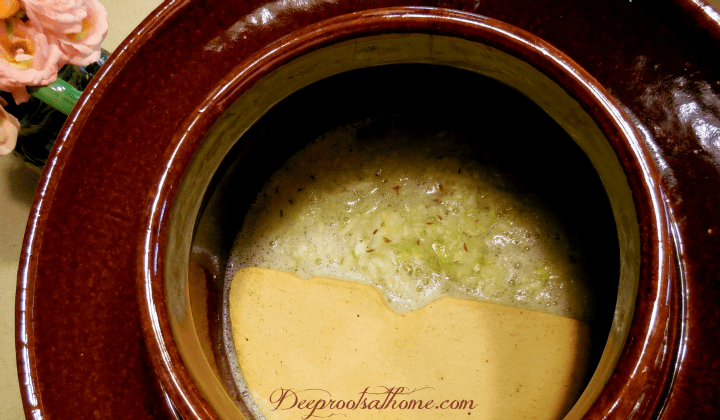
Homemade basic sauerkraut used to be a staple in every home.
Basic sauerkraut is the gateway of fermented foods. It’s straightforward and simple, the ingredients are inexpensive, and the reward is fairly quick.
It is wonderfully sour, slightly crunchy, and fantastic loaded onto a big sandwich for a burst of flavor or eating right out of the jar as a daily probiotic. (Basic sauerkraut is the stuff of warm Reuben sandwiches!) We love it so much we sometimes make it in large batches. If you are even slightly adventuresome, you will find it enjoyable, too.
Please do not be intimidated in the least; maybe I can take some of the mystery out of it for you.

Last post, I shared the ins and outs of how fermentation takes place in making a high quality sauerkraut ferment.
Today, I want to show the actual process of making basic sauerkraut from start to finish.
The idea of culturing vegetables first originated as a way to preserve food so it could be stored without the need for refrigeration. In the old days, usually in the fall seasons, Eastern European families prepared for winter by making several barrels of cultured cabbage, enough for the entire family to eat for many months.
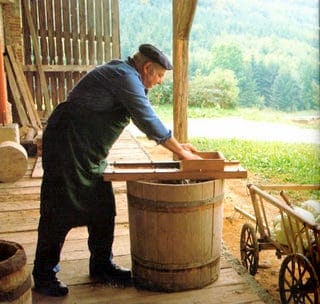
Above: Shredded cabbages for ‘choucroute’ the traditional way in the Alsace region of France ~ from a Taste of Alsace by Sue Style. Alsace Lorraine is the home of my father’s ancestors. (source)
“When you make sauerkrauts you are in fact concocting a vessel full of enzymes, lactobacilli and an alkaline reactive food source… a powerhouse of nutrition for your stomach, intestines, organs and entire body.” ~Sandor Katz
What Is Needed To Start
Simply, all you need is:
• cabbage,
• salt, and
• some sort of container to store it while it’s fermenting
• A small kitchen/postal scale would be helpful, too
While this post mainly focuses on fermenting basic sauerkraut in a covered crock, it is applicable to all types of containers.
Basic Sauerkraut Recipe
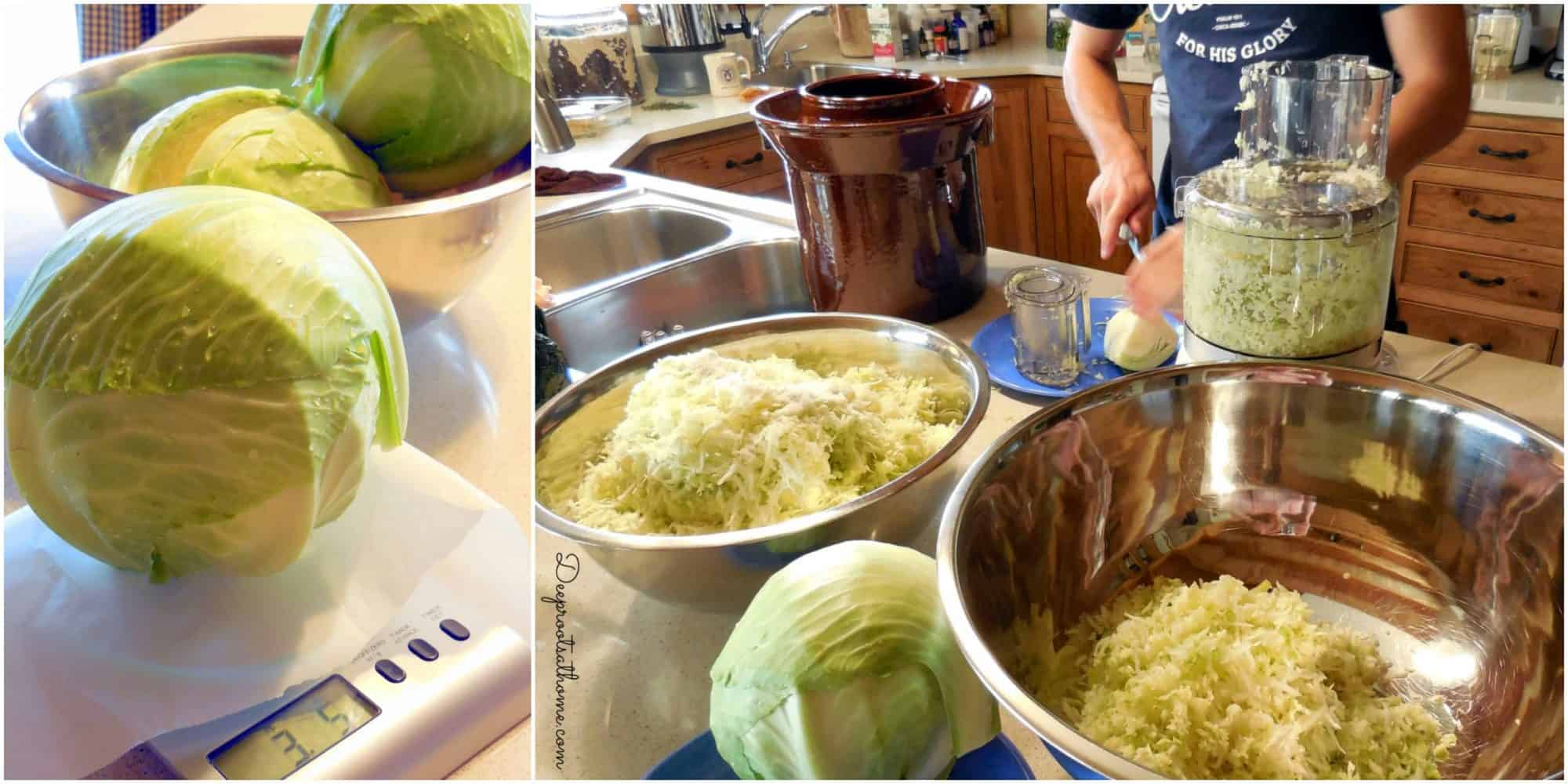
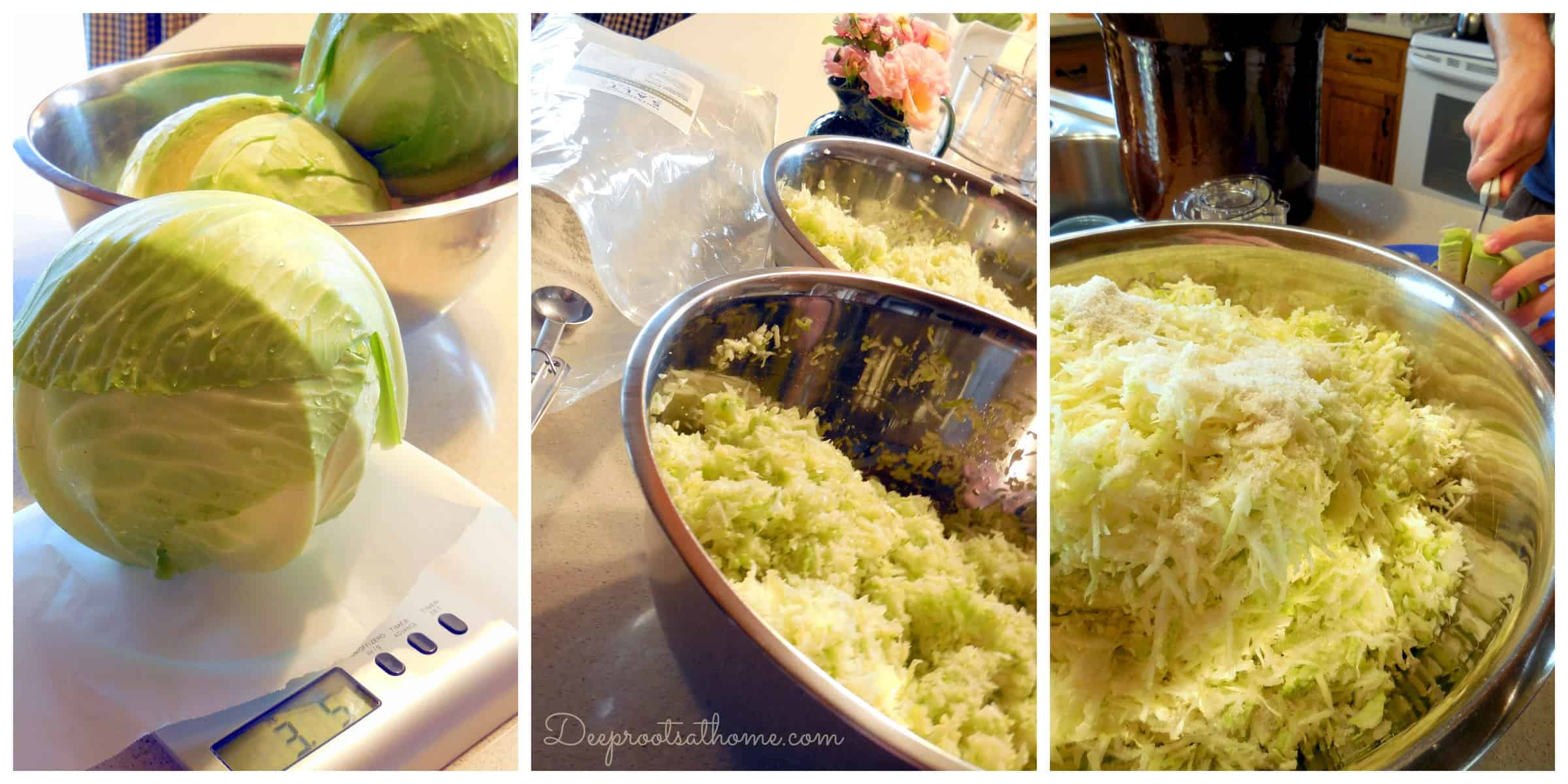
1.) Remove damaged or wilted outer leaves and core out a bit of the center stalk from the cabbage.
2.) Weigh your trimmed cabbages for a total weight and write it down for accuracy in measuring in the salt later.
3.) Using a food processor or a large knife, shred or chop the cabbage into a large pan(s), either finely or coarsely, according to your preference.
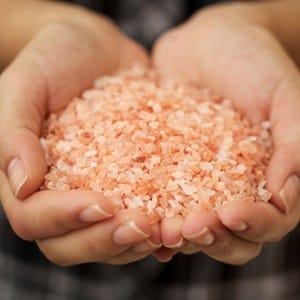
4.) Next, measure out your sea salt and mix well with your cabbage.
Rule of thumb, you will want to use about 3 tablespoons of high quality salt for every 5 lbs of cabbage, no more.
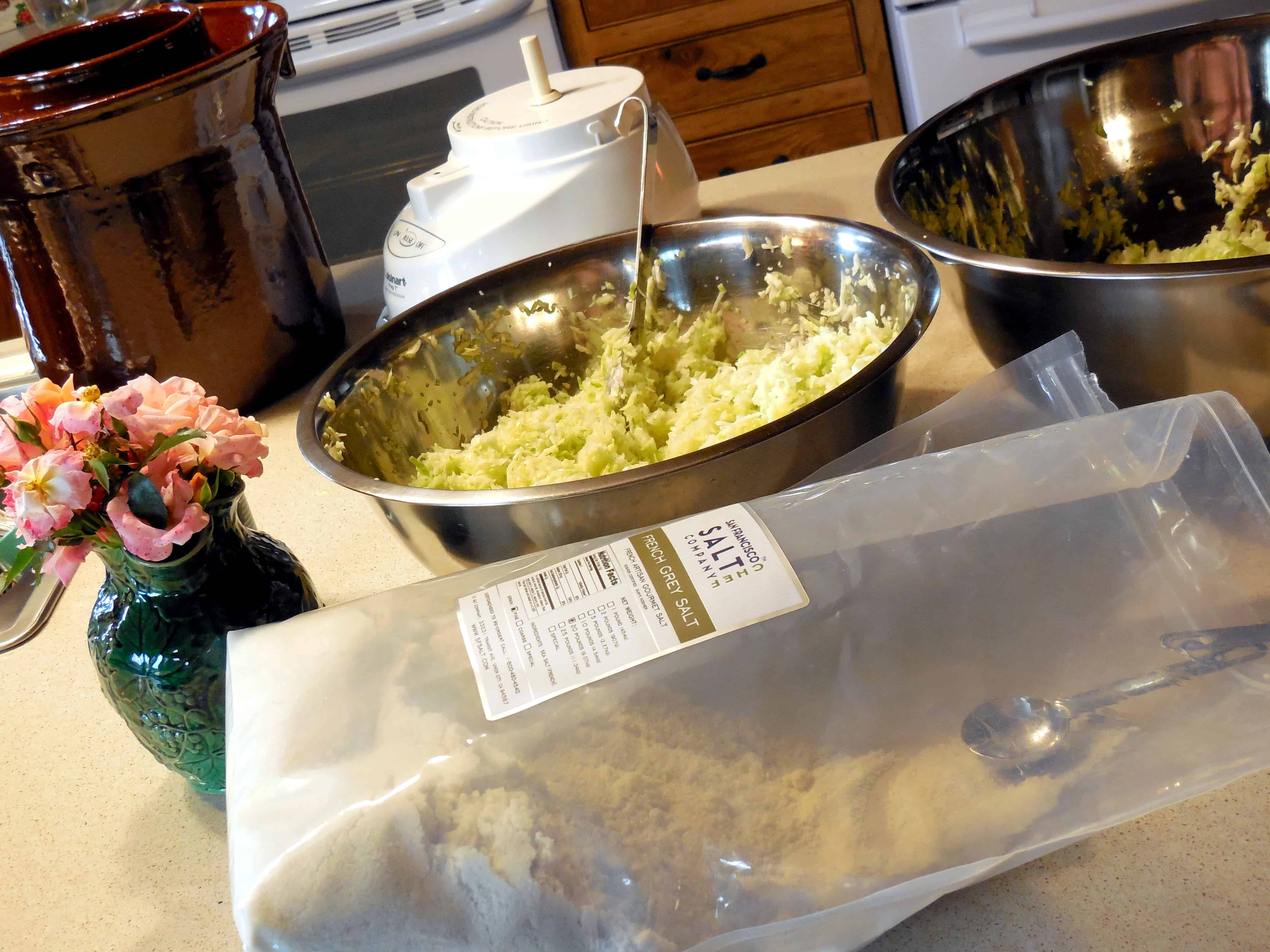
I like to think of this as 2 teaspoons per pound as many of my ferments are smaller than 5 pounds, and it’s easier to figure.
*Optional: stir in 3-4 tsp. of caraway seed if you like it really traditional. It is the flavor that compliments the rye bread in a Reuben sandwich! Caraway alone can stimulate digestion.
Many just learning to ferment add too much salt and inhibit fermentation.
• Too much will stop fermentation
• Too little will not be harmful
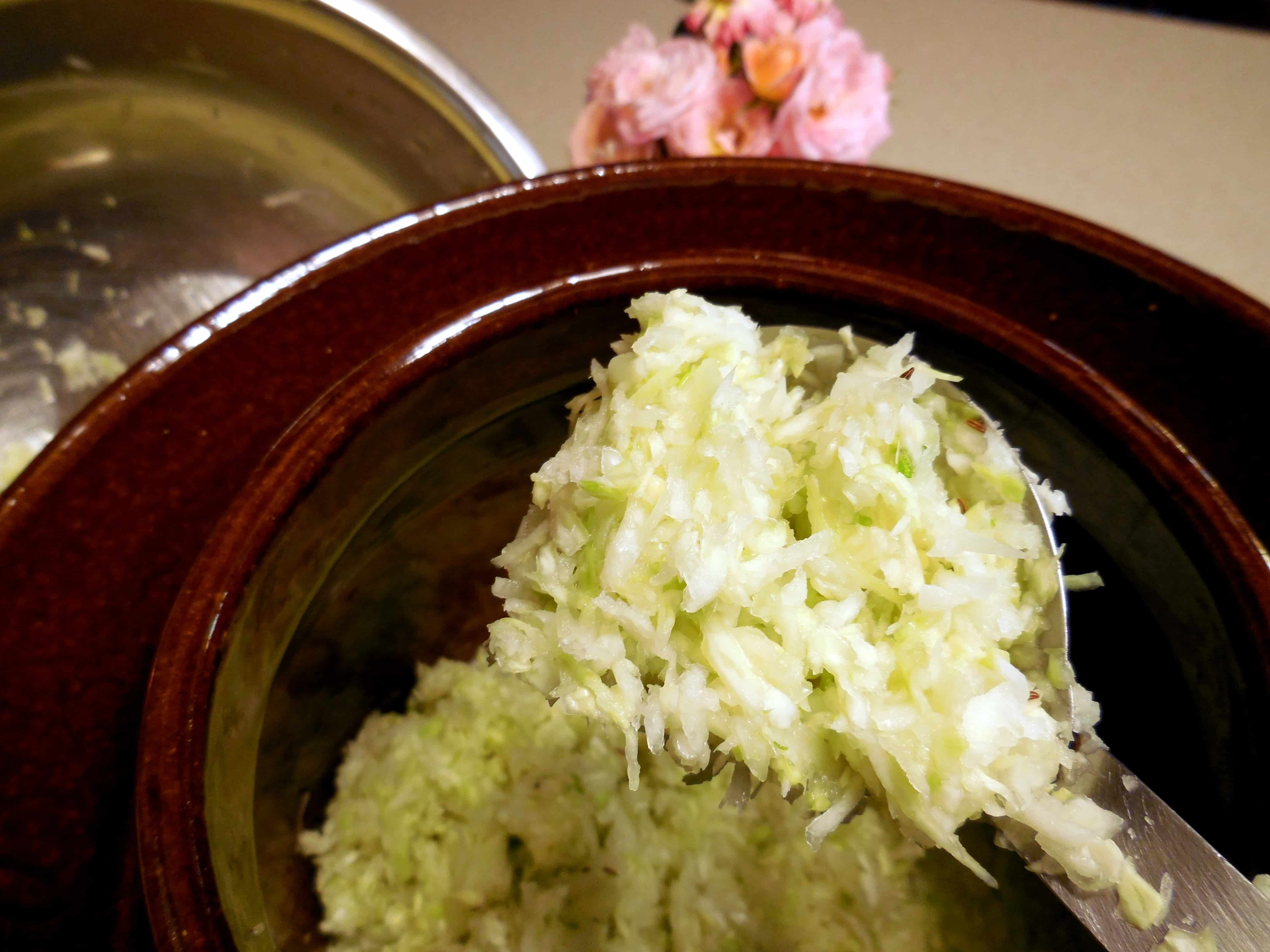
Here I used my big lidded crock
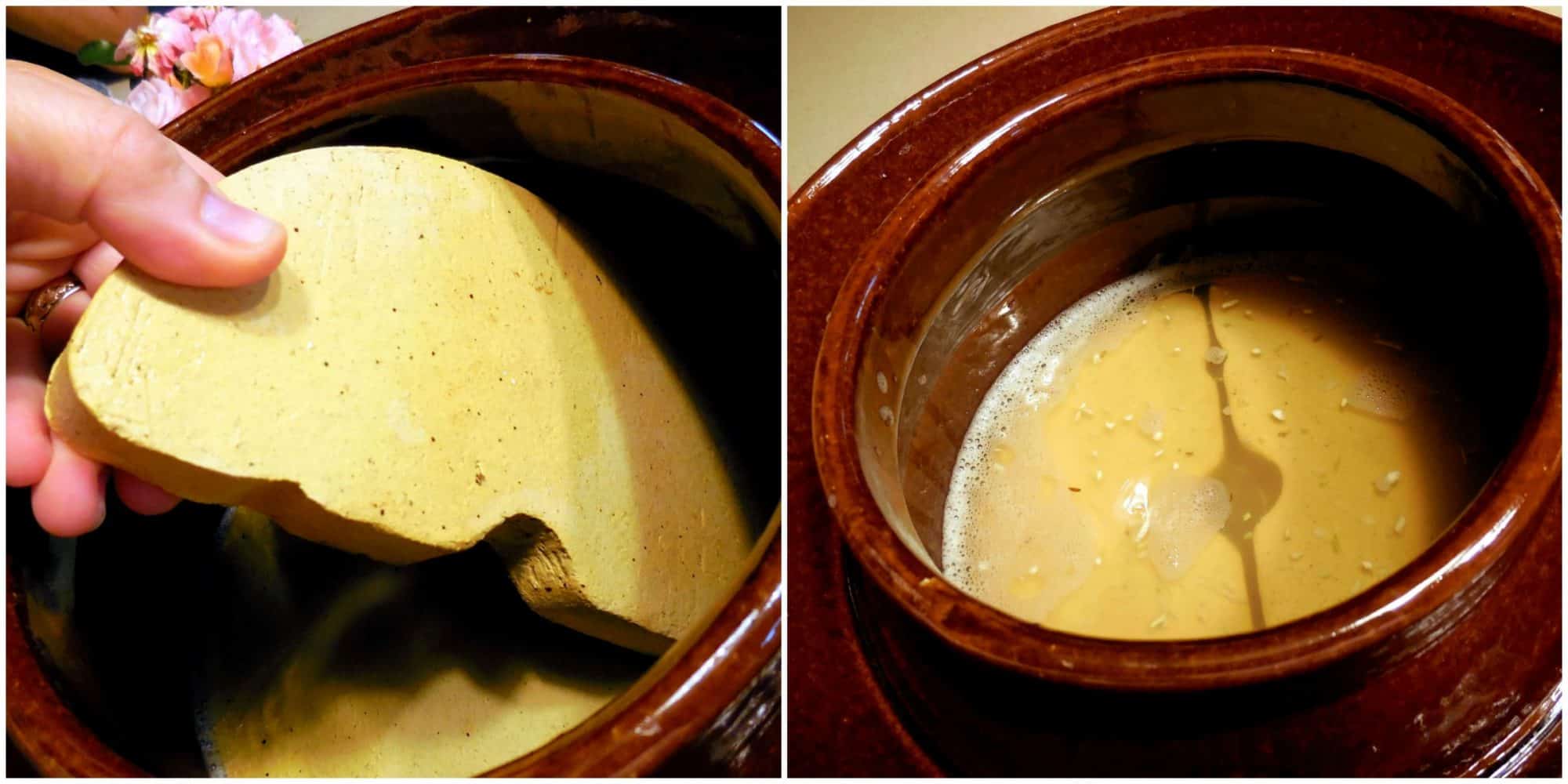
5.) Pack all the salted cabbage into your vessel; simply pack down firmly to remove all air pockets (no need to pound!), and the salt will begin to draw liquid our of the shredded mass. Depending on the age of the cabbage that you are using, it may take some time for the salt to draw out the juice. Don’t fill your container too much more than 4/5 of the way to the top.
6.) Next, submerge the cabbage one of several ways:
• If using a Fermenting crock
• If using an open crock with straight sides, you usually place a weighted plate over the cabbage to pack it down and keep it submerged. As the salt draws the liquid out of the cabbage leaves, the liquid level should rise to cover the plate.
• When fermenting in a wide-mouth canning jar, placing a smaller jelly jar filled with rocks or marbles into the mouth of the larger jar serves the same purpose. The liquid will rise with the displacement, yet hold the cabbage under the brine. You can also make a similar arrangement as you see here. The idea is to keep the cabbage submerged.
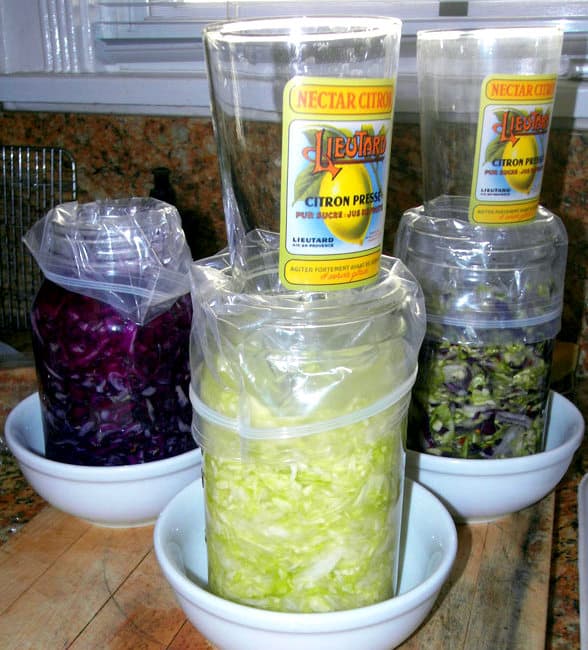
*In every case above, if there is not at least 1 inch of the liquid/brine covering the weights, pour some boiled and cooled salt water (make it at a concentration of about 1 tablespoon per 2 cups of water) into the crock so that the stones are submerged.
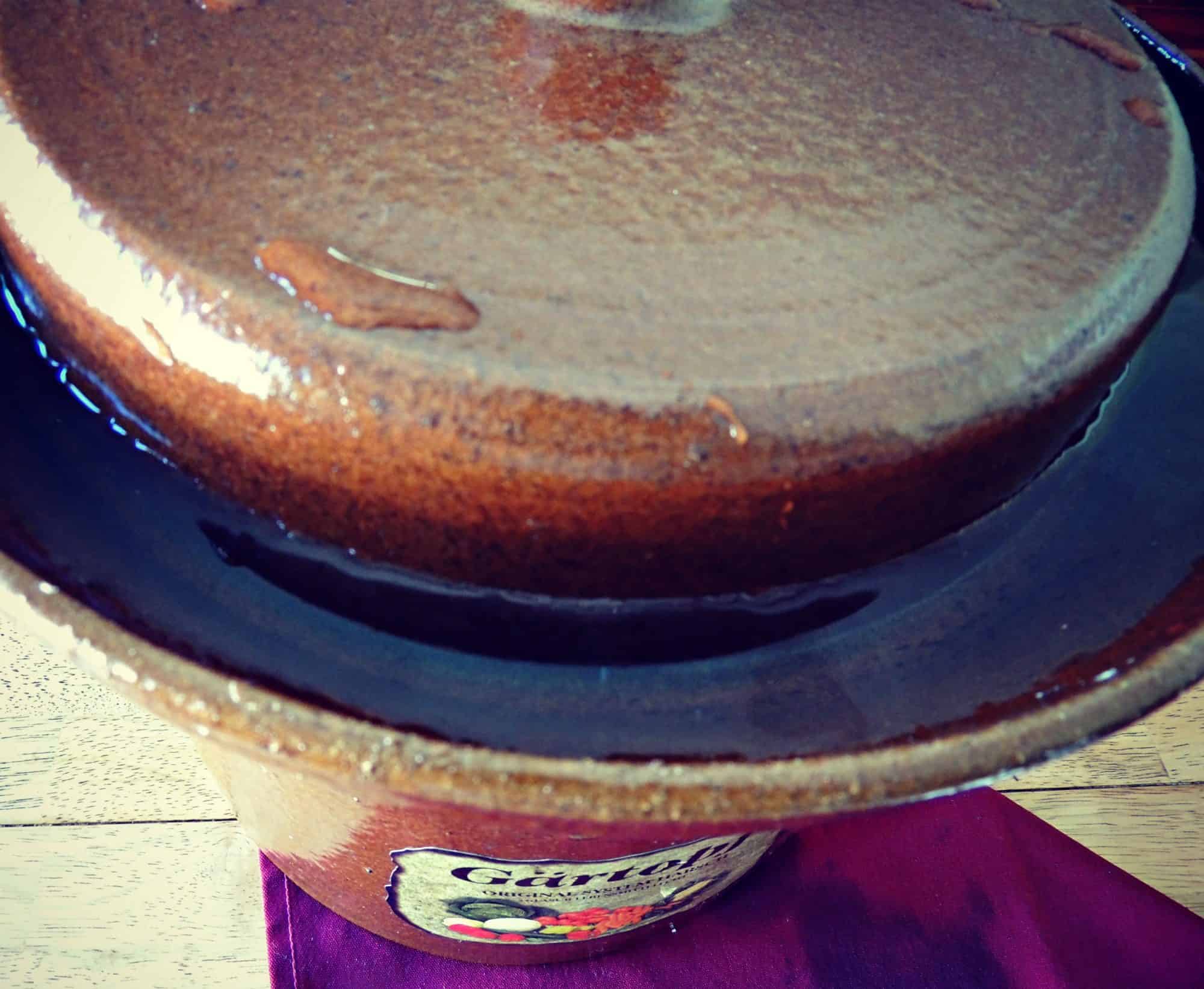
7.) Place the lid securely onto the crock and fill the surrounding water trough. This creates an incredible airtight seal that allows the lactic acid to work to its maximum capacity without the formation of undesirable film-forming yeast.
For me, the ‘waiting time’ of fermentation requires lots of patience to leave the developing sauerkraut alone and do its thing unseen. When I use the big covered Fermenting crock, I will not open it and break the water seal which keeps dust, molds or other undesirables out.
Some who use other types of vessels will peek at their sauerkraut from time to time and skim off occasional kahm yeast. I have never had kahm yeast with a covered, water-sealed crock.
But a rule of thumb for the highest quality fermentation in bigger batches is 15-20 days. For a smaller quart-sized batch, the minimum time is 3-8 days, though the kraut will continue to ferment and become tastier for many days after that.
• For the first 2-3 days, just leave the crock at room temperature (about 68-72° F). During this time, you may begin to notice a barely audible gurgling or bubbling sound…fermentation is moving right along. If it is more than 75 degrees, it will go soft and mushy.
• Day 4, move the crock into a cool place in your home or heated garage, somewhere that stays between about 64°-68° F. 65º is ideal. Less than 60 degrees, it may not ferment at all. I put ours on the floor near an outside (N) wall in our back hall where it is cool. I keep a little thermometer there.
• Be sure to monitor the level of the water seal as it may evaporate during this time. Take care to add water as needed so that the seal remains intact.
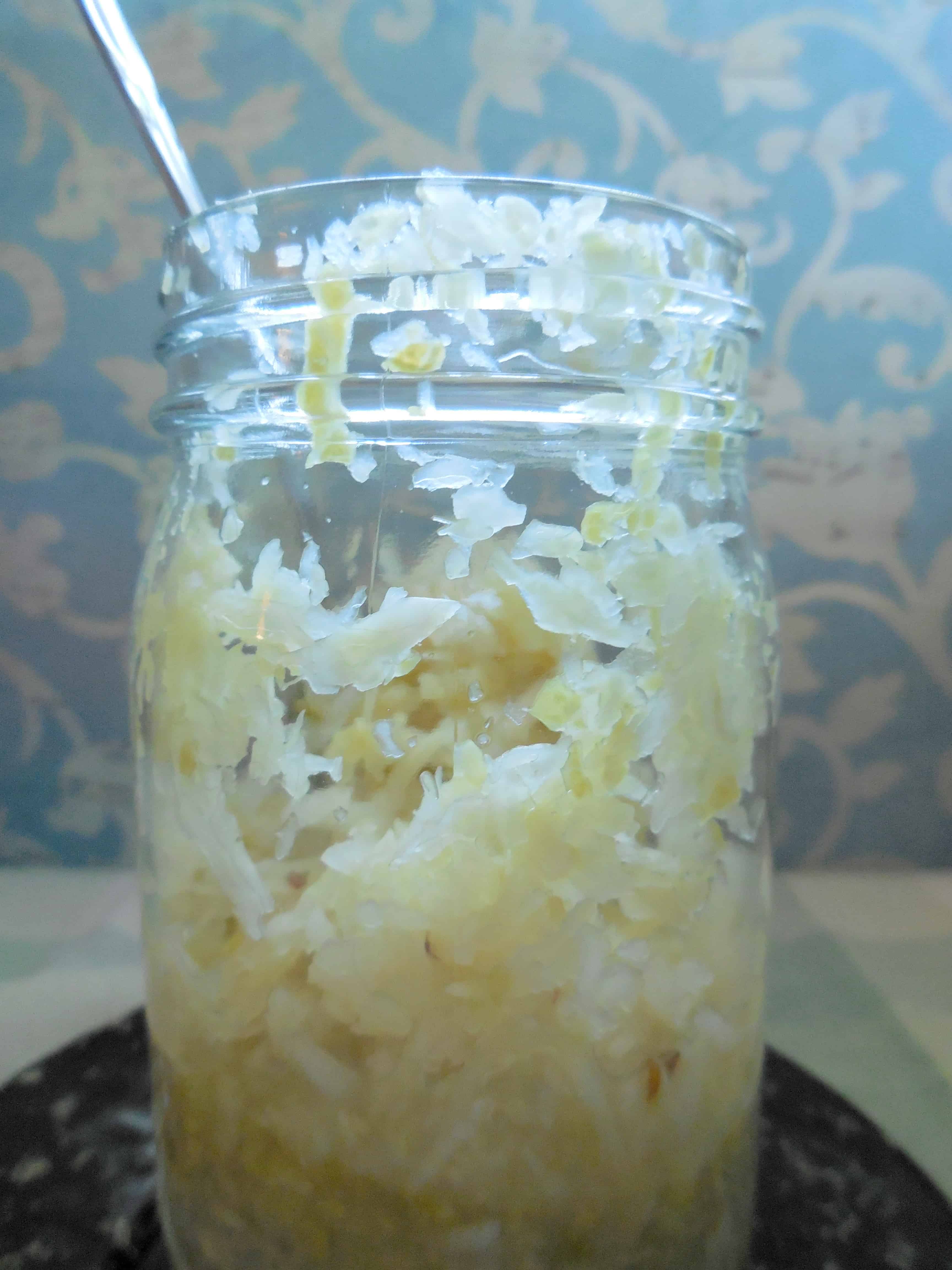
8.) Lastly, just spoon your wonderful finished fermented sauerkraut (aka:: the original probiotic) into clean jars with tight-fitting lids. Pack them tightly so the juices rise and the air pockets are out. This is my favorite part as I see the many filled jars!
FYI, the finished fermented sauerkraut can be kept at cellar temperature (around 55°F) for months, though those of us without cellars must make do with storing the kraut on an enclosed back porch, a unheated garage, or in the refrigerator.
So go ahead and be bold! I guarantee if you learn to make this gateway fermented food, you will be encouraged to do other things to lessen some of your dependence on outside sources.
Bon Appétit!

What’s the Salt Ratio For Making Sauerkraut?
***For the Full Spike Protein Protocol to protect from transmission from the “V” and to help those who took the “V”, go here.

Deep Roots At Home now has a PODCAST! We are covering everything from vaccines, parenting topics, alternative medicine. Head over today and like, share and download a few episodes!
I’d love to stay connected with you, and here is one way…

Censorship is real. My Pinterest account was suspended; but surprisingly part of my main board is still available through this link, and it scrolls down a long way!
You can also find me on Facebook, Gab, MeWe, X (Twitter), Instagram, and look for me on IG Stories.
And please join me for my FREE newsletter. Click here.
©2026 Deep Roots at Home • All Rights Reserved


















Janet
We love Sauerkraut! I usually make a large batch (or 2-3) every year. We always eat some with our meals. Especially breakfast. I don’t know why breakfast, but we do. Thanks for the reminder on the proper way of processing kraut.
Jacqueline
We like it at breakfast, too! Especially with eggs and my own sausage… https://deeprootsathome.com/men-love-meat-make-your-man-summer-sausage/
Thanks for the encouragement, Janet. Blessings!
Charlotte Moore
We tried sauerkraut years ago. A friend told us what she did and we tried it. No go!! We had to pour it all out. I would like to try a couple quarts of this.
Hope I can post this message. For some reason I have been having trouble leaving messages on some blogs.
Trust you are doing well. GOD BLESS!!!
Jacqueline
Charlotte, I sure wish you were my next door neighbor! I really need a friend (real close) who is like-minded…it may be part of missing my mother (not that you are much older – I have no idea how old you are!) I’d love to make sauerkraut with you and our batches would both be ready at the same time!! Anyway, enough of wishing. I am very thankful for your friendship and encouragement through the years.
May the Lord put a special hedge of protection and peace all around you and your dear family.
(((Hugs)))
Jedidja
I always buy in int store. For 1 euro 🙂
Jacqueline
Jedidja, at that price, it’s not fair 😉 🙂 Here we pay between $11 and $14 for a pint! I’m assuming it is all raw there in Holland.
Miss you!
Heidi @ PintSizeFarm
Oh my goodness, I need this! Much to my hubby’s dismay (he is not a sauerkraut fan) it is one of the few things I can’t seem to get enough of in this pregnancy. Thanks for your submission to the HomeAcre hop. Feel free to stop by http://www.PintSizeFarm.com or any of the hosts again this week to submit another 🙂
Jacqueline
Yay for sauerkraut!!! Your body must know you need it 🙂 I am now praying for your pregnancy, Heidi!!
God bless you, friend 🙂
Sandra
I am going to have to try this. My husband loves Sauerkraut.
Thanks for sharing at the HomeAcre Hop. Pinning to our Faves Board 🙂
Terri Presser
What a great post and great idea, thanks for sharing this at Good Morning Mondays. Blessings
Lori Trafford
Hi there
Back in the day my Dad would make sauerkraut every fall. He was a very old school Hungarian man. I can still see him sitting there on the chair with the crock by his knees shredding away ( with the traditional old box style like your photo above!) and then he would pound and pound, tasting here and there and tossing in the odd bit of caraway every so often. Then a well worn old piece of oak and his “kraut rock” would go over the whole shebang topped with a tea towel to keep out the flies. You could hear it bubbling away after a few days and after a week or so his biggest problem was keeping everyone out of it until it was done 🙂
I do have a question and am not just rambling down memory lane here. When you jar them (Dad’s never lasted long enough to jar as he gave most of it away) does it need to be processed in any manner or just into sterile jars and lid them up? I want to make some, but want to ensure my little project doesn’t go bad. Can it spoil?
Jacqueline
Hi, Lori! Yes, it can spoil! I do not process it bc it will kill the good enzymes. I just jar and lid the jars and eat it! Consider making smaller batches until you have the hang of it!
Blessings, J
Linda
Hi,
My husband and I made Sauerkraut for the first time yesterday, we have it in
the basement but the temp is probably about 63-64 F. We do not have a water
lock cover so we covered the crock with a cloth and then put plastic over it to seal it. Will this work, do I need to open it to let it burp everyday?? Our crock is a
4 gallon and we have it almost 3/4 full. Any suggestions for us?
Jacqueline
Hi, Linda! I am conflicted on what to tell you bc for decades and centuries, many people made kraut and stored it in the cool basement/cellar for the time span required, with or without a waterlock. Problem I have personally is opening it and maybe introducing something in there that can spoil it… on the other hand, when you open it, you will be able to skim off any kahm yeast etc. (quickly and don’t sneeze or cough on it) and then close it up.
I’m going to punt and with that information, let you decide. Kraut making is an art and a little bit of luck, too. I have prayed over my krauts before!
Blessings to you and I hope you have a fabulous turnout! ~Jacque
linda
I’m sorry, i may have written that wrong. we do have a 2” brine
lock with a weight . we just don’t have a tight lid on the crock.
I put a cloth, then plastic and then a rubber band around the
crock. It is definitely bubbling! Should I open it and check for
yeast or just let it go for 2-3 weeks? Thank you so much for
being available for questions.
Linda
Jacqueline
Hi, Linda! Thanks for clarifying! I think since it is all submerged, I would open and skim it every few days! Good that it is bubbling!!!!
Can’t wait for you to have that magnificent kraut! I’d love to know how it turns out! ~J
Debbie Cole
do you rinse the saurkraut before putting in jars? We are doing our crocked saurkraut today and couldn’t remember if we had to rinse it before jarring.
Jacqueline
Hi, Debbie!
No, do not rinse it! It would introduce different bacteria into it and it would spoil. I’m glad you asked! Jacque
Jane Dvorak
Hello everyone. I make my own kraut and follow the directions of my husband’s Grandmother. I make mine in a crock and start by putting a layer of shredded cabbage a couple of inches deep, then I sprinkle a good dusting of canning salt and press down with my hands until the cabbage begins to make water. Grandma taught me to lick the back of my hand and if it tastes like salt water, you have the right amount. Keep adding layers of cabbage and canning salt (the subsequent layers all add up so you will be able to adjust the salt amount and keep tasting the “water” to get it right. I keep some whole leaves to layer on the top. Then I double bag water in a large (heavy duty) plastic bag (tap water in the inner bag and it is tied off but given slack so it “seals” to the inner edge of the crock), and the outer bag is put on the crock and the inner bag is put on top, this locks the smell in and the dust out. I drape the outer bag over the crock and am able to check on the kraut progress by lifting the edge of the outer bag and lifting the whole leaves to access the product. Right now I am playing around with the processing time, I learned to leave it 6 weeks, but I may can mine in 4-5 this time to see the difference. The stories were that years ago they would allow the kraut to freeze in the front porch and Grandpa would chip off a hunk and bring it in to thaw. I can mine but am going to keep a jar of fresh in the refrigerator after reading the posts.
Jacqueline
Jane, thank you for this insight to your method! I would love it if you have pictures of the different bagging steps to avoid confusion as I am not exactly sure what that looks like. If you have any photos, I can email you and may be you would be willing to share them!
Blessings to you! And God be with us all!
Jacqueline
Briannaa
I am into second week of fermentation in German crock with lid.
It’s in cool side of kitchen. Today I was using oven baking, after few hours notice that water mouth change colour. It became white film over the water.
What should I do ? Can you help me?
I have 5 litres crock.
Thank you kindly, Briannaa
Jacqueline
Hi, Briannaa!
I am thinking your kitchen is still too warm making the fermenting go too fast. when that happens, the air bubbles will push liquid up and into the water trough. It is a large crock, but if you can move it to a cooler area, I would certainly do so. Remember temp is one of the big 4 factors. https://deeprootsathome.com/making-basic-kimchi/
I’m praying you can get this to a cooler place soon and save this batch!
Hugs… I know how bad it hurts when one goes wrong!
Jacque
John Biggie
when putting the sauerkraut in my jars, I ran short on brine to fill the jars. Is it ok to boil some water made some additional salt water and add it to the jars so that the sauerkraut is covered?
Jacqueline
John, I would just make more brine as you made the rest and add it. Yes, you must have it all covered and not floating or open to the air!
Good luck!
Jacque