
Dear tired Parent, does your child have focus, sensory, or behavioral challenges or been diagnosed with ADHD, Dyspraxia, or Dyslexia?
The ADHD, Dyspraxia, Dyslexia Umbrella
Research suggests that there is a series of related conditions (dyslexia, ADHD, and dyspraxia) which can overlap, so an affected child is likely to display a combination of problems. Some children have only one of these disorders but many have two or all three leading to problems that are extremely distressing both for the child and his or her parents. Such problems often lead to disruptive behavior and school failure. (source)
Follow along with me and discover how it might be a serotonin issue —and how we can reduce these symptoms and begin to reverse them without drugs.
Low Serotonin Metabolism Impacts ADHD, Behavior, Mood and Focus
It takes lots of energy to stay focused on something which isn’t interesting to you. If your child’s body isn’t producing enough serotonin, his or her ability to focus will be greatly impaired. Serotonin is a neurotransmitter which is mostly manufactured in the gut (intestines.)
Early research, done by doctors like Dr. Leo Galland,
If your child has “leaky gut” (like my son had after a severe mold exposure), this can be devastating. There are more causative factors than mold – like antibiotic use for sure and probably childhood vaccines – but they are certainly beyond the scope of this writing.
(Plus, this study links consuming Glyphosate with poor Vitamin D uptake, **impaired serotonin synthesis**, impaired heme (synthesis, and hypoxia-related autism. Wow! I think that means we would be wise to avoid all GMO foods that disrupt our normal biological function.) (source)
Btw, as a Deep Roots reader, you can now use this link to get 15% off of a wide array of the highest quality nutritional supplements, many that you already know and love (including probiotics). Or save 25% if you order as a client of Ana who is a Nutrition Therapist Master (NTM).
How are ADHD, leaky gut and low serotonin connected?
Inside our bellies, we have an extensive intestinal lining covering more than 4,000 square feet of surface area. When working properly, the intestinal mucosa forms a tight barrier that controls what gets absorbed into the bloodstream. An unhealthy gut lining has cracks or holes, allowing partially digested food and toxins to penetrate the blood supply. This triggers widespread inflammation and bacterial imbalances within the digestive tract.
In fact, 95% of our serotonin, the key neurotransmitter responsible for regulating mood, is made in a healthy gut, so if your gut is messed up, you’re more likely to feel the effects of depression and anxiety and have symptoms of ADHD. (source)
Dr. Amy Myers states, “If you’re dealing with chronic digestive issues like IBS, leaky gut, Candida overgrowth, or SIBO, there’s a good chance your serotonin production is being impaired. Having low serotonin creates a vicious cycle. You see, serotonin plays a crucial role in ensuring your body absorbs nutrients properly, so it affects both your physical and mental health.” (For more of the intricacies on serotonin beyond the scope of this post, go here).
My own son was a sad example of this as he switched from a calm, relatable 4-year old to a hitting, kicking and crying mess with pain in his gut and eczema from his knees to his ankles. The reason he didn’t grow much at all for years (approximately age 4-11) is because he was not digesting and absorbing his food, plus it wrecked his regulation of mood terribly. (Thankfully, he is a healthy adult, husband and father of 3 today because we followed the approach in this post. Of course, this is not all of the story, but a big part of it).
And mold is just one of the ways a gut microbiome can get ruined. Antibiotics, vaccine adjuvants, allergy shots, steroids can all be causative or contributing factors.
When your gut doesn’t contain the right amount of beneficial bacteria, your body will not be able to metabolize as serotonin, food, or much else as it should. Also, the yeast in your system can grow out of control.
A child like this usually gets labeled, but that might be prevented in some or many cases.
Having an upset gut ecology causes many symptoms (to varying degrees) in children and adults, including:
• Inattention: Difficulty staying focused, spaciness, poor follow through on tasks, delayed language, memory problems (math facts, spelling, etc.), or listening.
• Hyperactivity: Fidgeting, restlessness, and an urge to move constantly, inappropriate behavior such as talking loudly, getting into other people’s space, etc..
• Impulsivity: Acting without thinking, anger/irritability/aggression, mood swings, interrupting others, or difficulty waiting one’s turn.
• Sensory issues: Food textures bother, won’t eat meat, chews on clothing, very selective eater (carbivore), sensitive to loud noises, dislikes being in a group – wants to escape, clothing tags bother them, dislikes stiffer clothing such as jeans.
• Physical issues: Stomach aches, leg pains, food allergies (esp. dairy), bedwetting, anxiousness, sleep issues, eczema/rashes, constipation, carb cravings, repeated ear infections, and night terrors.
These are not character traits, but SYMPTOMS from which we might be able to give a child some relief.
If these statements describe your child THERE IS HOPE. Your child may be suffering from a low level of serotonin metabolism.
Serotonin metabolism’s beneficial effects help ADHD, behavioral issues:
• Relaxes the mind
• Instills a sense of well-being
• Helps us handle stress
• Keeps our mind focused
• Promotes falling asleep and staying asleep through the night
• Is a natural antidepressant
• Helps us control impulses
• Gives us a more positive outlook on life
You can see how a lack of serotonin metabolism would put a real burden on anyone’s system.
Many of those labeled with ADHD are put on Ritalin or some other psychotropic drug in order to help with Attention and Behavioral issues. We are told Ritalin works by helping our bodies to release serotonin.
But Ritalin also has numerous nasty side-effects, some of which are quite dangerous.
We All Need Quality Essential Fatty Acids Like DHA:
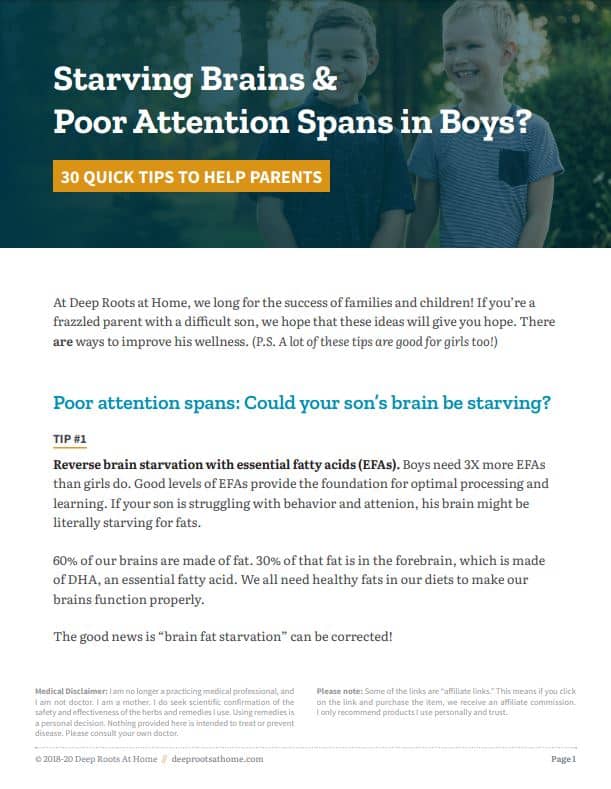
Recent studies verify what studies as far back as the 1980’s also discovered– that many children (and adults) who live with dyslexia, dyspraxia and learning differences as well as ADHD demonstrate deficiency in essential fatty acids –as well as other key brain nutrients. (source)
Low fat diets have disastrously been encouraged for the last few decades and our brain health and neurotransmitters (like serotonin) have suffered as a result. (source) Consider these astounding facts:
• The brain is ~60% fat (when dried) and 20% of that fat is DHA (long chain essential fatty acids).
• 30% of the fat in your retina is also DHA.
• The area of your brain that has the highest concentration of DHA is responsible for maintaining focus and attention.
• Fats are needed for the proper absorption of fat soluble vitamins (A,D,E, and K)
• Individuals who have poor co-ordination, balance and dexterity are often deficient in EFA’s (DHA)
• Fats are essential for manufacturing our hormones (serotonin is also considered a hormone)
Signs of Essential Fatty Acid Deficiency
• Bumpy, ‘chicken skin’ on backs of arms
• Dandruff or dry hair
• Inability to focus, sit still, hyperactivity
• Anxiety, depression
• Slow wound healing
• Decreased immunity
• Excessive thirst
• Dry skin, eyes
Dr. Berg briefly discusses Omega-3 essential fatty acids for ADHD.
4 minutes.
Supporting this, Dr Jacqueline Stordy’s research on fifteen dyspraxic children who were seriously clumsy, showed substantial objective improvement when treated for three months with a supplement of high DHA fish oil. This made a noticeable improvement in the children’s dexterity and balance over three months. In practical terms this lead to improved writing skills, better balance, behavior and co-ordination. (source)
These Simple Changes Can Help Behavioral Issues:
Functional medicine tools for altering the gut microbiome therapeutically include changes in diet and probiotics. (source)
Suggested supplements for you or your child to take:
1. Here are 2 good DHA options: NOW Foods DHA-500 softgels and Nature’s Way Mega-DHA softgels.
For a small child, a MINIMUM according to Dr. Strody’s study, would be approximately 500 mgs. of DHA. (source) For an older child, proportionately more mgs would be appropriate. Softgels can be punctured with a pin and squeezed into a child’s mouth or applesauce, but some children will chew them or swallow with no problem. This can be supplemented indefinitely.

Here is a liquid option: Some liquid fish oil supplements taste icky or make you burp up a fishy taste – this Barlean’s product does not. The flavors are yummy and 1 teaspoon/day is right at 500 mg).
2. Take this Probiotic

Another option to alternate (every 3-4 months) with the one above is this chewable tablet by Jarrow every day. See how it works in this post.
3. Get Rid of Excess Yeast – Use an antifungal agent such as Grapefruit Seed Extract
4. Reduce/eliminate sugar or sugary carbs – Try to reduce sugar & carbs by increasing protein and good fats, especially at breakfast and snacks. This helps build up the adrenal gland which stabilizes mood and energy.
5. This post on Brain Starvation will show you how to increase protein (leaning towards carnivore) and good fats in a practical way your child will appreciate.
(And if you have a child that’s had multiple ear infections and were on antibiotics as babies, either Acidophilus or Pro-Kids ENT Probiotic paired with grapefruit seed extract three times a day, can really help. Some parents notice a difference within days!)
While some children may genuinely require medication for their behavioral issues, attention and focusing difficulties, that isn’t always the case. I pray you can will try some of the above dietary changes before going the more dangerous medication route.
Especially when you know what a positive impact it could have on your child’s behavior.
Btw, as a Deep Roots reader, you can now use this link to get 15% off of a wide array of the highest quality nutritional supplements, many that you already know and love (including probiotics and fish oils). Or save 25% if you order as a client of Ana who is a Nutrition Therapist Master (NTM).

***If you found value in this writing, please share it, discuss it, and subscribe to my FREE newsletter. Independent, ad-free work like this spreads because of readers like you.
Also, please consider supporting my work by using my Amazon affiliate link when purchasing from there.

Censorship is real, so my Pinterest account was suspended; thankfully, a big part of my main board is still alive through this link!
You can also find me on Facebook, Gab, MeWe, X (Twitter), and Instagram.
****For the Full Spike Protein Protocol to protect from transmission from the “V” and to help those who took the “V”, go here.
©2026 Deep Roots at Home • All Rights Reserved








Related